
Every business needs an accountant, and every accountant resume that's worthy of a prospective employer's attention needs to measure up on multiple counts.
Accountants know that attention to detail and careful calculation are requirements for a job well done, but it turns out that applies to resume writing as well. Your resume offers a first impression to the hiring team, so it's important to make it a good one.
Resume guide for an accountant resume
Fitly here to help. Our resume builder and field-tested resume examples for over 500 professions will give you the advantage to stay ahead in your pursuit of a dream accountant job. This resume guide and corresponding accountant resume example will cover the following topics:
- Choosing the right resume format for accounting
- Include your contact information
- Make use of a summary
- Outline your accounting work experience
- Include the relevant key skills
- Detail your education & certifications
- Pick the right resume layout and design
Let's dive in!
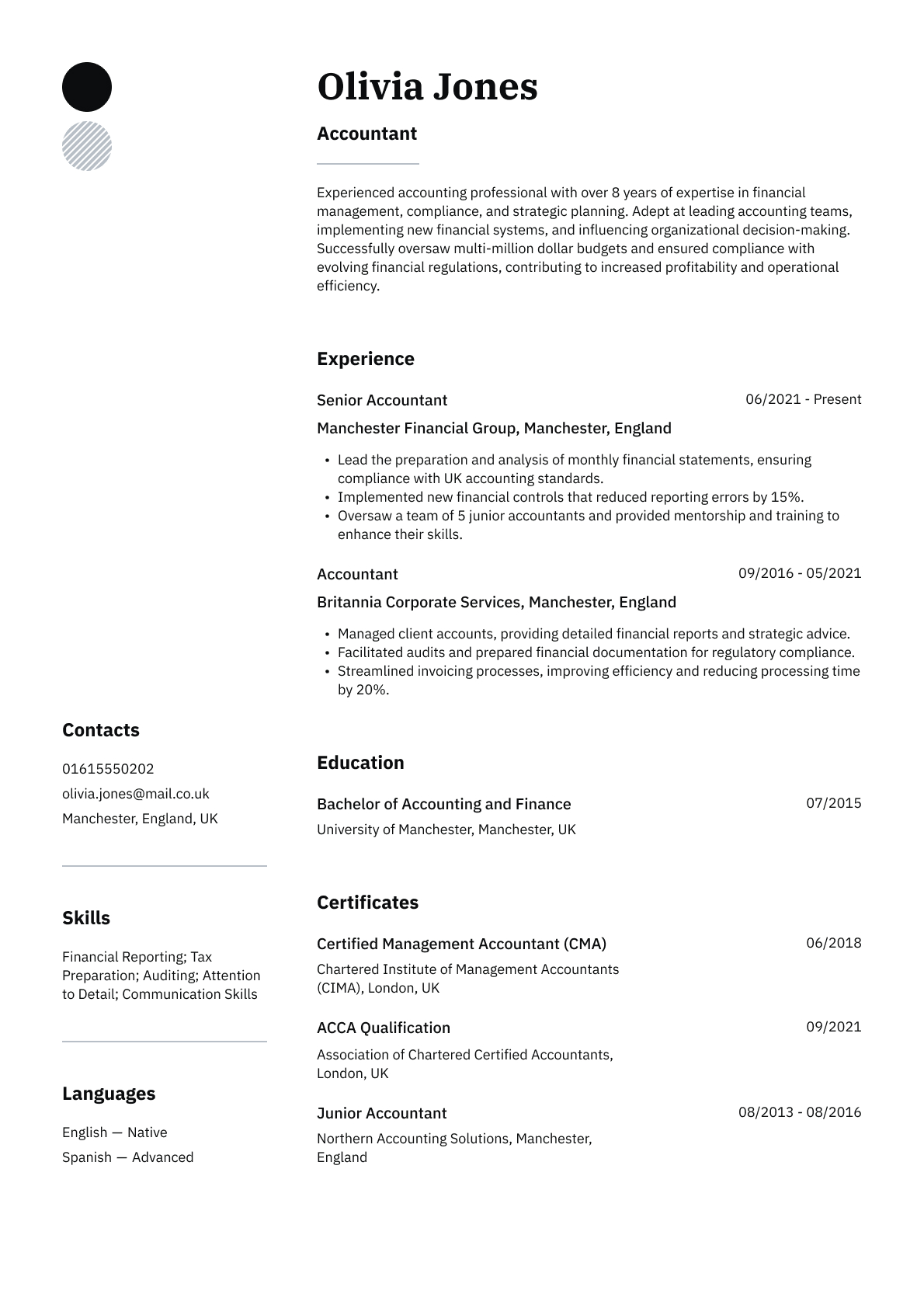
Resume example (text format)
Olivia Jones
Accountant
olivia.jones@mail.co.uk 01615550202 Manchester, England, UK
Profile
Experienced accounting professional with over 8 years of expertise in financial management, compliance, and strategic planning. Adept at leading accounting teams, implementing new financial systems, and influencing organizational decision-making. Successfully oversaw multi-million dollar budgets and ensured compliance with evolving financial regulations, contributing to increased profitability and operational efficiency.
Work Experience
06/2021 - Present, Senior Accountant, Manchester Financial Group, Manchester, England
- Lead the preparation and analysis of monthly financial statements, ensuring compliance with UK accounting standards.
- Implemented new financial controls that reduced reporting errors by 15%.
- Oversaw a team of 5 junior accountants and provided mentorship and training to enhance their skills.
09/2016 - 05/2021, Accountant, Britannia Corporate Services, Manchester, England
- Managed client accounts, providing detailed financial reports and strategic advice.
- Facilitated audits and prepared financial documentation for regulatory compliance.
- Streamlined invoicing processes, improving efficiency and reducing processing time by 20%.
08/2013 - 08/2016, Junior Accountant, Northern Accounting Solutions, Manchester, England
- Assisted in maintaining accurate ledger entries and reconciling accounts.
- Supported senior staff in preparing budgets and financial forecasts.
- Developed proficiency in accounting software including Sage and QuickBooks.
Education
07/2015, Bachelor of Accounting and Finance, University of Manchester, Manchester, UK
06/2018, Certified Management Accountant (CMA), Chartered Institute of Management Accountants (CIMA), London, UK
09/2021, ACCA Qualification, Association of Chartered Certified Accountants, London, UK
Skills
- Financial Reporting
- Tax Preparation
- Auditing
- Attention to Detail
- Communication Skills
How to write an accountant resume
Before you get started, you need to know what your accountant resume should include. Here are the necessary sections:
- Profile
- Work Experience
- Education
- Skills
Your resume should reflect the unique value you bring as an accountant. To start, gather as much information as possible about the company and role to which you're applying. Try to understand the company's needs and plan to showcase how you are exactly the right accountant to solve their problems. To do this well, stick to this formula:
- Highlight your accomplishments, not just your job duties. Anyone can list the tasks they were assigned, but showcasing your specific achievements will further prove your value.
- Tailor your resume for each application you submit by adjusting the style and tone to match that of the employer.
- Convey a professional, streamlined image with a resume template that's polished, not stuffy or overly formal.
- Include relevant keywords to make sure the reader or system can understand exactly what you've accomplished.
Choosing the right resume format for accounting
Your resume should be straightforward, professional, and easy to understand — the same qualities of a great accountant.
While there are various resume formats, the best option is the reverse chronological format. This format showcases your most recent experience first then works backwards into your past roles.
For those who are hoping to make a career transition or otherwise have a unique background, a functional format, which focuses on skills and talents rather than employers, may be useful. In other instances, a hybrid (combination) resume format makes sense in adapting chronological and functional elements.
Spend some time exploring the resume templates in our resume builder and select the format that best suits your situation. There are plenty of versions of each format available as resume examples, as well.
Be sure to use a clean modern or professional layout for your accountant resume, as this will reflect your professional brand.
Include your contact information
The resume header is your opportunity to make it clear whose resume the reader is viewing and how to contact you. It's imperative to make this as easily accessible as possible while ensuring it's presented professionally.
What sort of information should you include?
- Your name
- Your email address
- Your phone number
- Your LinkedIn profile (if applicable)
Don't include:
- Your address
- Personal details
Make use of a summary
Accounting is typically characterized as a technical profession, but that should not stop you from infusing some personality in your accountant resume. In particular, the summary (sometimes called a profile) of your accountant resume is the place for adding the human dimension. It also gives you a chance to challenge certain stereotypes about financial professionals being dry or uncooperative by nature.
Think of your accountant resume summary as a story of expertise and character. In fact, this is really the only resume section where you can employ a bit of creativity, since it's relatively freeform while most other resume sections have standard formatting in bullet points.
Make sure to use energetic language, action verbs, and positive statements. and let some character to shine through. Don't just repeat information from your resume in different words; instead, use this area to provide overarching themes about who you are, how you work, and what you've achieved.
You can find adaptable accountant resume example summaries below:
Entry-level adaptable resume summary/profile example
Motivated recent accounting graduate with a strong academic record and foundational knowledge of financial principles. Eager to apply analytical skills and attention to detail in a professional environment. Demonstrates a willingness to learn new accounting software and procedures, with a proactive attitude towards supporting team goals.
Mid-level adaptable resume summary/profile example
Skilled accountant with over 3 years of experience managing financial statements, reconciliations, and audits. Proven track record of reducing errors by 15% and improving reporting efficiency through process improvements. Proficient in QuickBooks, Excel, and SAP, with the ability to analyze complex financial data and comply with regulatory standards.
Senior adaptable resume summary/profile example
Experienced accounting professional with over 8 years of expertise in financial management, compliance, and strategic planning. Adept at leading accounting teams, implementing new financial systems, and influencing organizational decision-making. Successfully oversaw multi-million dollar budgets and ensured compliance with evolving financial regulations, contributing to increased profitability and operational efficiency.
Outline your accounting work experience
In accordance with a reverse chronological format, list your current or most recent job at the top of this section and work your way back from there. Don't go back more than 10-15 years; while your earlier experience is no doubt valuable, it may not be as relevant as more recent work. Plus, it can invite ageism.
Only include information that is directly related to the kind of role you're targeting. If you have other experience you'd like to add, consider an "Other Experience" section to capture it.
Beneath each employer and title heading, detail your contributions and achievements in succinct, specific bullet points. Omit the use of personal pronouns like "I" and "my." Start each bullet point with an action verb that reflects your impact: managed, budgeted, analyzed, saved, assessed.
Don't just list your job duties. Instead, demonstrate tangible outcomes. It's best if you can include specific numbers. Without that level of specificity, your resume may seem a bit bland — and who wants to further that accounting stereotype?
For example, these bullets could be written by anyone:
- Handled accounting and financial analysis
- Analyzed budgets for the company as needed
- Filed financial reports and records
They're vague and nonspecific, right? Look what happens when you add more context:
- Managed accounting and financial analysis for 100-person organization as sole accountant on staff
- Saved $200k per year through careful budget analysis and uncovering unneeded expenses
- Improved accuracy and timeliness of financial report filing, achieving compliance for the first time
Take a look at the accountant employment history resume sample below:
Accountant employment history resume sample
06/2021 - Present, Senior Accountant, Manchester Financial Group, Manchester, England
- Lead the preparation and analysis of monthly financial statements, ensuring compliance with UK accounting standards.
- Implemented new financial controls that reduced reporting errors by 15%.
- Oversaw a team of 5 junior accountants and provided mentorship and training to enhance their skills.
09/2016 - 05/2021, Accountant, Britannia Corporate Services, Manchester, England
- Managed client accounts, providing detailed financial reports and strategic advice.
- Facilitated audits and prepared financial documentation for regulatory compliance.
- Streamlined invoicing processes, improving efficiency and reducing processing time by 20%.
08/2013 - 08/2016, Junior Accountant, Northern Accounting Solutions, Manchester, England
- Assisted in maintaining accurate ledger entries and reconciling accounts.
- Supported senior staff in preparing budgets and financial forecasts.
- Developed proficiency in accounting software including Sage and QuickBooks.
Include the relevant key skills
Accounting focuses on hard skills, and an accounting resume typically reflects that in about 90% of the content. However, you'll want both hard and soft skills to showcase your comprehensive expertise. Hard skills are those that are measurable, like experience with accounting software or particular financial regulations. On the other hand, soft skills are those that pertain more to how you think and work with others, like dependability, strong communication, or complex problem-solving.
Keep in mind that your accounting resume should be concise and tailored to the specific accounting position you are seeking, so you don't need to include every single skill every time. One of the best tools for being selective about each specific resume skills section is your own master list. Create a separate document with just a bullet point list of your competencies and keep it handy for updating constantly. Then, for each new version of your accountant resume, analyze the job requirements and choose the most appropriate skills for your resume.
Fitly offers several pre-written key skills to choose from when using the resume builder. You can also write in additional skills.
Here's what the skills box looks like in our accountant resume template:
Accountant key skills resume sample
- Financial Reporting
- Tax Preparation
- Auditing
- Attention to Detail
- Communication Skills
Detail your education & certifications
Your resume's education section is where you can show the academic achievements that make you a great accountant. Because accounting is typically not a self-taught profession, hiring teams expect you to bring some education and it's important to display it here. Accountants typically have an undergraduate degree in accounting, business, or finance, and may have an advanced degree on top of that.
Assuming you have a bachelor's or master's degree, there's no need to list your high school credentials. Do, however, include certifications or trainings related to accounting. Think about:
- Accounting certifications, particularly if you've earned designation as a Certified Public Accountant (CPA). Other certifications include Certified Management Accountant (CMA), Association of Chartered Certified Accountants (ACCA), and Chartered Institute Management Accountant (CIMA).
- Industry-specific certifications like Certified Bank Auditor (CBA), Certified Fraud Examiner (CFE), Certified Information Systems Auditor (CISA), Certified Internal Auditor (CIA) and Enrolled Agent (EA).
- Professional development, including relevant training courses and memberships in accounting-related professional associations.
- Internships, especially if you're a recent graduate or new to the industry.
Accountant education & certifications resume sample
07/2015, Bachelor of Accounting and Finance, University of Manchester, Manchester, UK
06/2018, Certified Management Accountant (CMA), Chartered Institute of Management Accountants (CIMA), London, UK
09/2021, ACCA Qualification, Association of Chartered Certified Accountants, London, UK
Pick the right resume layout and design
Appropriate layout, design, and formatting are the foundation for attracting and focusing the recruiter’s attention on your accountant resume. Together, they create the first impression hiring managers will have.
To convey character and a professional image on your accounting resume, a clean and classical look is your best choice. Accountants are often associated with discipline, dependability, and expertise, so let's visualize that in your resume template.
Before choosing a template, reflect on what that resume format says about you as a candidate. For most formal accounting positions, you'll want to keep your template fairly simple. However for certain employers, a more creative or modern touch might be effective.
For more ideas, take a look at our field-tested resume templates, where the most tedious formatting and structure tasks are done for you.
Accountant job market and outlook
Accounting is a field that is always in demand. The job market for accountants is expected to grow by 5% from 2021 to 2031, according to the Bureau of Labor Statistics. This is faster than the average for all occupations.
The demand for accountants is expected to be driven by the growing economy and the need for businesses to manage their finances effectively.
The average salary for an accountant is $60,000 per year, according to the Bureau of Labor Statistics. The top 10% of earners make over $100,000 per year.
The job market for accountants is expected to be strong in the coming years. The demand for accountants is expected to be driven by the growing economy and the need for businesses to manage their finances effectively.
The average salary for an accountant is $60,000 per year, according to the Bureau of Labor Statistics. The top 10% of earners make over $100,000 per year.
Key takeaways
Accounting is a profession consistently in demand. The job outlook for accountants forecasts a 5% growth rate from 2021 to 2031, according to the U.S. Bureau of Labor Statistics, outpacing the average for all careers.
The increasing need for precise financial management in businesses propels the demand for qualified accountants.
The average annual salary for accountants is approximately $60,000, with top professionals earning over $100,000 per year.
The accountant job market remains robust and competitive, driven by economic expansion and organizational financial oversight requirements.
Overall, a career in accounting offers stability, growth potential, and attractive compensation for dedicated professionals.
