
Every organization requires meticulous record management, and an archivist resume must demonstrate expertise in preserving, organizing, and providing access to valuable historical documents and records.
Archivists understand the significance of accuracy and careful documentation, principles that are equally vital when crafting an effective resume. Your resume is your first opportunity to impress hiring managers, so make sure it reflects your dedication and professionalism.
Resume guide for an archivist resume
Fitly here to help. Our resume builder and field-tested resume examples for over 500 professions will give you the advantage to stay ahead in your pursuit of a dream archivist job. This resume guide and corresponding archivist resume example will cover the following topics:
- Choosing the right resume format for archivists
- Include your contact information
- Make use of a summary
- Outline your archivist work experience
- Include the relevant key skills
- Detail your education & certifications
- Pick the right resume layout and design
Let's dive in!
Resume example (text format)
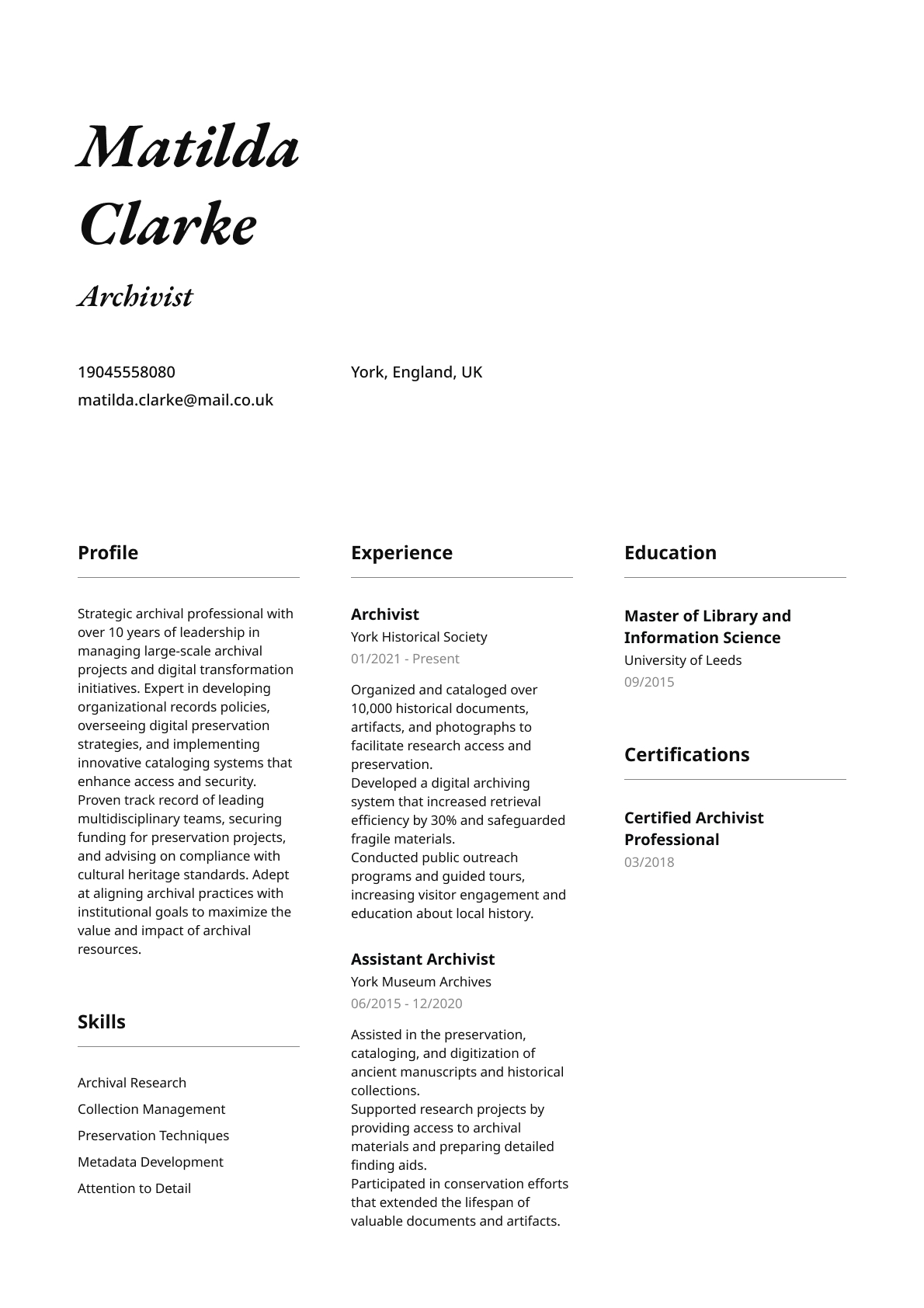
Matilda Clarke
Archivist
matilda.clarke@mail.co.uk 19045558080 York, England, UK
Profile
Strategic archival professional with over 10 years of leadership in managing large-scale archival projects and digital transformation initiatives. Expert in developing organizational records policies, overseeing digital preservation strategies, and implementing innovative cataloging systems that enhance access and security. Proven track record of leading multidisciplinary teams, securing funding for preservation projects, and advising on compliance with cultural heritage standards. Adept at aligning archival practices with institutional goals to maximize the value and impact of archival resources.
Work Experience
01/2021 - Present, Archivist, York Historical Society, York, England
- Organized and cataloged over 10,000 historical documents, artifacts, and photographs to facilitate research access and preservation.
- Developed a digital archiving system that increased retrieval efficiency by 30% and safeguarded fragile materials.
- Conducted public outreach programs and guided tours, increasing visitor engagement and education about local history.
06/2015 - 12/2020, Assistant Archivist, York Museum Archives, York, England
- Assisted in the preservation, cataloging, and digitization of ancient manuscripts and historical collections.
- Supported research projects by providing access to archival materials and preparing detailed finding aids.
- Participated in conservation efforts that extended the lifespan of valuable documents and artifacts.
08/2012 - 05/2015, Junior Archivist, York County Records Office, York, England
- Processed incoming archival materials, ensuring proper handling, labeling, and storage procedures.
- Assisted senior staff with detailed cataloging, indexing, and maintaining digital databases.
- Supported community outreach by organizing workshops and informational sessions on local history preservation.
Education
09/2015, Master of Library and Information Science, University of Leeds, Leeds, UK
06/2010, Bachelor of Arts in History, University of York, York, UK
03/2018, Certified Archivist Professional, Society of Archivists, UK
Skills
- Archival Research
- Collection Management
- Preservation Techniques
- Metadata Development
- Attention to Detail
How to write an archivist resume
Before you get started, you need to know what your archivist resume should include. Here are the necessary sections:
- Profile
- Work Experience
- Education
- Skills
Your resume should reflect the unique value you bring as an archivist. To start, gather as much information as possible about the organization and role to which you're applying. Understand their needs and plan to highlight how you are precisely the right archivist to preserve and manage their valuable collections. To do this effectively, follow this approach:
- Emphasize your accomplishments, not just your responsibilities. Anyone can list their tasks, but demonstrating your specific contributions will add significant value.
- Customize your resume for each application by adjusting the style and tone to align with the employer’s culture and expectations.
- Maintain a professional, streamlined appearance with a polished resume template that conveys credibility without appearing overly formal.
- Use relevant keywords so that both hiring managers and applicant tracking systems clearly recognize your expertise and achievements.
Choosing the right resume format for archivists
Your resume should be clear, professional, and easy to navigate—qualities that align with the role of an effective archivist.
The reverse chronological format is typically the best choice as it highlights your most recent experience first and demonstrates career progression.
If you are changing careers or have a varied background, consider a functional format which focuses more on skills and relevant expertise than on employment history. Alternatively, a hybrid format that mixes chronological and functional elements can work well.
Explore various templates in our resume builder to find the format that best suits your professional story. Remember to select a clean and modern design that reflects your organized and detail-oriented nature.
Include your contact information
The resume header should clearly present whose resume it is, along with accessible and professional contact details.
Include the following:
- Your full name
- Your professional email address
- Your phone number
- Your LinkedIn profile or professional portfolio link (if applicable)
Avoid including:
- Your home address
- Personal information unrelated to the job
Make use of a summary
Archivist roles require both technical expertise and a passion for preserving history, and your resume summary is the ideal place to convey this combination.
Think of your summary as a brief narrative that balances your professional skills and personal dedication to archival work. This section allows more creative language than the typical bullet points used elsewhere.
Use dynamic language, action verbs, and optimistic phrasing to make your personality and professionalism stand out without merely restating your resume details.
Below are adaptable example summaries for archivists at various stages of their careers:
Entry-level adaptable resume summary/profile example
Motivated recent graduate with a strong foundation in archival science, records management, and digital preservation. Eager to apply learned methodologies in organizing and maintaining historical collections, with a keen eye for detail and a passion for cultural heritage. Possesses excellent research and documentation skills, along with proficiency in archival software and digital tools. Enthusiastic about contributing to institutional preservation efforts and gaining practical experience in archival practices.
Mid-level adaptable resume summary/profile example
Experienced archivist with 4 years of managing diverse collections, digitization projects, and implementing records retention policies. Successfully increased accessible digital archives by 30%, improving retrieval efficiency for research teams. Skilled in using archival management systems such as Archivists' Toolkit and CONTENTdm, with strong attention to metadata standards and preservation best practices. Able to lead small teams and coordinate with cross-departmental stakeholders to ensure preservation and accessibility of collections.
Senior adaptable resume summary/profile example
Strategic archival professional with over 10 years of leadership in managing large-scale archival projects and digital transformation initiatives. Expert in developing organizational records policies, overseeing digital preservation strategies, and implementing innovative cataloging systems that enhance access and security. Proven track record of leading multidisciplinary teams, securing funding for preservation projects, and advising on compliance with cultural heritage standards. Adept at aligning archival practices with institutional goals to maximize the value and impact of archival resources.
Outline your archivist work experience
Following the reverse chronological order, position your current or most recent archivist role at the top, then proceed backward. Limit your experience to the last 10-15 years to maintain relevance and avoid potential age bias.
Include only roles pertinent to archival work. For unrelated experience, consider adding a separate section titled "Additional Experience."
Under each position, use clear, impactful bullet points to describe your responsibilities and achievements. Avoid personal pronouns like “I” or “my.” Start bullets with action verbs such as cataloged, preserved, digitized, facilitated, or curated.
Rather than listing duties, focus on measurable results and specific accomplishments that demonstrate your impact.
For instance, generic entries like these:
- Managed archival records
- Organized files and documents
- Maintained historical data
Can be transformed into detailed achievements:
- Cataloged and preserved over 10,000 historical documents with 99% accuracy, improving retrieval times significantly
- Digitized fragile manuscripts to enhance preservation and accessibility, reducing physical handling by 40%
- Developed and implemented a new classification system that streamlined archival searches, resulting in a 25% efficiency increase
Review the archivist employment history example below for inspiration:
Archivist employment history resume sample
01/2021 - Present, Archivist, York Historical Society, York, England
- Organized and cataloged over 10,000 historical documents, artifacts, and photographs to facilitate research access and preservation.
- Developed a digital archiving system that increased retrieval efficiency by 30% and safeguarded fragile materials.
- Conducted public outreach programs and guided tours, increasing visitor engagement and education about local history.
06/2015 - 12/2020, Assistant Archivist, York Museum Archives, York, England
- Assisted in the preservation, cataloging, and digitization of ancient manuscripts and historical collections.
- Supported research projects by providing access to archival materials and preparing detailed finding aids.
- Participated in conservation efforts that extended the lifespan of valuable documents and artifacts.
08/2012 - 05/2015, Junior Archivist, York County Records Office, York, England
- Processed incoming archival materials, ensuring proper handling, labeling, and storage procedures.
- Assisted senior staff with detailed cataloging, indexing, and maintaining digital databases.
- Supported community outreach by organizing workshops and informational sessions on local history preservation.
Include the relevant key skills
Archivist positions demand a balance of technical expertise and interpersonal skills. Hard skills include proficiency with archival software, cataloging systems, and knowledge of preservation techniques, while soft skills relate to communication, problem-solving, and attention to detail.
Your resume should feature the most relevant skills tailored to the specific archivist role you're applying for. Maintain an updated master list of your skills, then selectively include those aligning with each job description.
Fitly offers a selection of pre-written key skills when building your resume, with space to add custom skills as well.
Here’s an example of skills that often appear in archivist resumes:
Archivist key skills resume sample
- Archival Research
- Collection Management
- Preservation Techniques
- Metadata Development
- Attention to Detail
Detail your education & certifications
The education section showcases your academic background relevant to archival science and history, underscoring your qualifications to manage and preserve records.
Archivists commonly hold degrees in archival studies, library science, history, or related fields. Advanced degrees can further strengthen your candidacy.
Include relevant certifications or professional trainings such as:
- Certified Archivist (CA) designation from the Academy of Certified Archivists
- Records Management Certification
- Specialized training in digital preservation or archival software
- Memberships in professional organizations like the Society of American Archivists (SAA)
- Internships or fellowships, especially if you are entering the field
Archivist education & certifications resume sample
09/2015, Master of Library and Information Science, University of Leeds, Leeds, UK
06/2010, Bachelor of Arts in History, University of York, York, UK
03/2018, Certified Archivist Professional, Society of Archivists, UK
Pick the right resume layout and design
A well-organized and visually clear layout is essential to making your archivist resume stand out and communicate professionalism.
Choose a clean, classic design that reflects organization and precision, key traits of successful archivists.
Before finalizing your template, consider what your resume’s design conveys about you as a candidate. For traditional archival institutions, simplicity and clarity are paramount, while some modern workplaces may appreciate a subtle creative touch.
Explore our carefully designed, field-tested templates to find one that streamlines your story and leaves a positive impression.
Archivist job market and outlook
The demand for archivists remains steady as organizations increasingly recognize the importance of preserving their historical assets.
According to labor statistics, employment for archivists is projected to grow moderately over the next decade, supported by growing digital records management needs and historical preservation initiatives.
The average salary for an archivist varies by experience and location but typically falls around $55,000 per year, with senior roles commanding higher compensation.
Opportunities exist in government agencies, museums, libraries, universities, and private corporations, offering a diverse employment landscape.
Strong organizational skills and technological proficiency will continue to be crucial for success in this evolving field.
Key takeaways
Archivist roles require precision, dedication, and a passion for preserving history and culture. The job market offers steady opportunities bolstered by increasing awareness of record keeping’s importance.
Building a resume that highlights both technical competence and your unique contributions to archival projects will position you as a top candidate.
Advancing your education and earning relevant certifications can enhance your qualifications and salary potential.
The ability to manage both traditional and digital archives effectively is increasingly sought after and should be emphasized in your resume.
Choosing a clean, professional resume layout will support your presentation as an organized and reliable professional ready to contribute meaningfully to archival preservation.
