
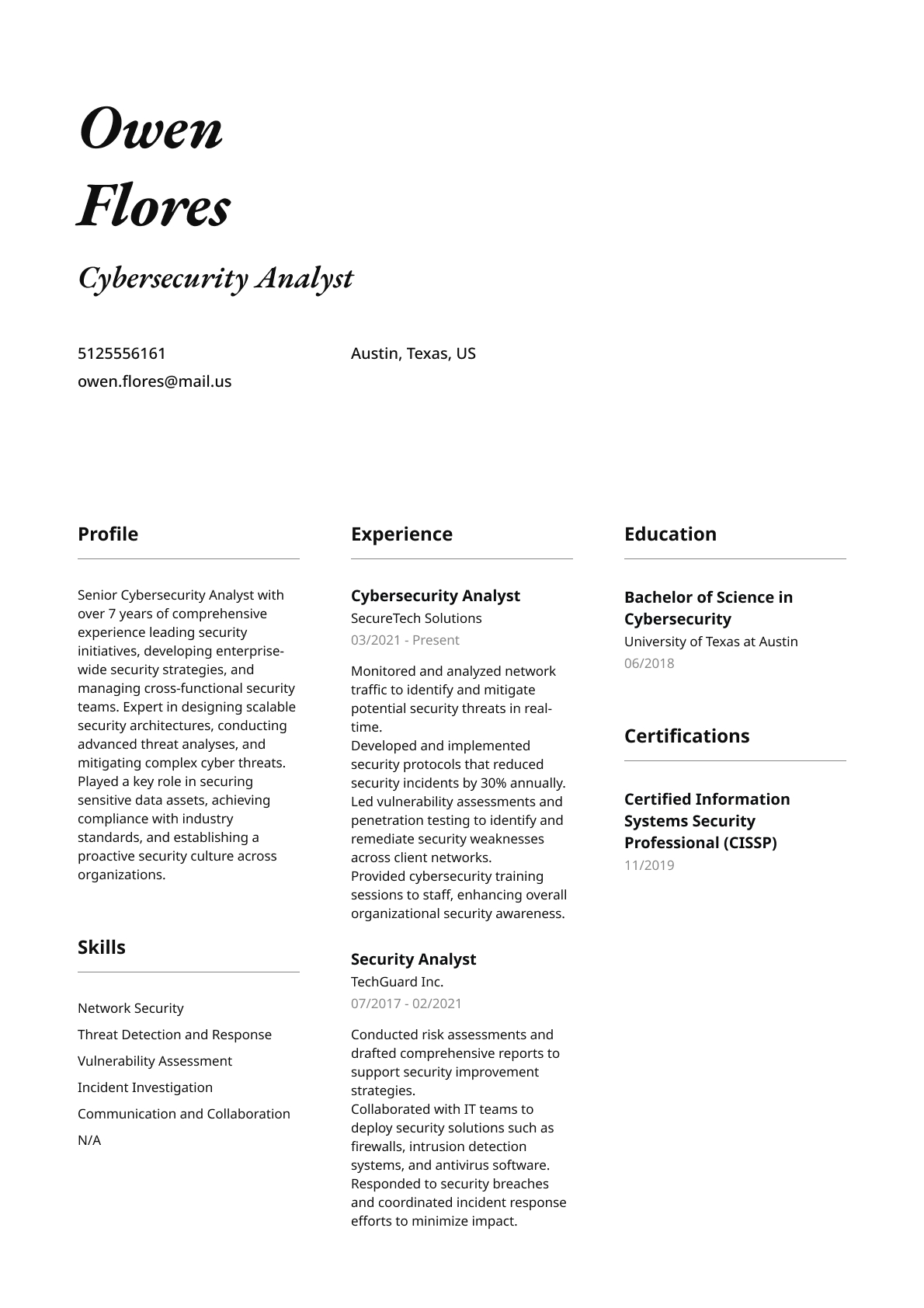
Every organization requires a cybersecurity analyst, and every cybersecurity analyst resume that captures the attention of hiring managers must excel on multiple fronts.
Cybersecurity analysts understand that vigilance, analytical skills, and rapid response are essential for protecting digital assets, and these qualities also apply to crafting your resume. Your resume serves as the first impression to potential employers, so it’s crucial to make it compelling and precise.
Resume guide for a cybersecurity analyst resume
We are here to assist you. Our resume builder, along with tried-and-tested cybersecurity analyst resume examples across various industries, will help you stand out in your quest for the ideal cybersecurity analyst position. This guide and the accompanying resume example will address the following components:
- Selecting the optimal resume format for cybersecurity roles
- Including accurate and professional contact information
- Utilizing an impactful professional summary
- Detailing cybersecurity work experience clearly
- Highlighting critical technical and soft skills
- Presenting relevant education and certifications
- Choosing the suitable resume layout and design
Let's get started!
Resume example (text format)
Max Taylor
Cybersecurity Analyst
max.taylor@mail.us 4805557788 Scottsdale, Arizona, US
Profile
Strategic Cybersecurity Leader with more than 7 years of experience directing enterprise security programs and teams. Expertise in developing comprehensive security architectures, managing risk assessments, and responding to complex security incidents. Successfully led initiatives that aligned security strategy with business objectives, resulting in increased resilience and compliance across multinational organizations. Demonstrates strong leadership in fostering security awareness, mentoring staff, and driving innovation to mitigate evolving cyber threats.
Work Experience
01/2021 - Present, Cybersecurity Analyst, SecureTech Solutions, Scottsdale, Arizona
- Monitored network traffic and security logs to identify and respond to potential threats in real-time.
- Developed and implemented security protocols that reduced phishing incidents by 30% within the first year.
- Conducted vulnerability assessments and coordinated with IT teams to remediate security gaps.
- Provided cybersecurity training sessions to over 150 staff members, enhancing overall security awareness.
06/2017 - 12/2020, Information Security Specialist, DataShield Inc., Phoenix, Arizona
- Supported the deployment of enterprise-wide security solutions, including intrusion detection and prevention systems.
- Performed regular security audits and risk assessments to maintain compliance with industry standards.
- Assisted in incident response efforts, successfully mitigating several attempted data breaches.
08/2014 - 05/2017, Security Analyst, TechSecure Corp., Scottsdale, Arizona
- Analyzed security alerts and escalated significant incidents to appropriate teams for investigation.
- Developed detailed reports on security incidents and recommended improvements to prevent recurrence.
- Participated in the development of company-wide cybersecurity policies and procedures.
Education
09/2022, Certified Information Systems Security Professional (CISSP), ISC2, Remote
06/2018, Bachelor of Science in Cybersecurity, Arizona State University, Tempe, AZ
01/2016, CompTIA Security+ Certification, CompTIA, National
Skills
- Network Security
- Incident Response
- Threat Analysis
- Risk Management
- Communication Skills
How to write a cybersecurity analyst resume
Before starting, it’s important to understand the essential components of your cybersecurity analyst resume. These key sections typically include:
- Professional Profile
- Work Experience
- Education
- Skills
Your resume should reflect the unique expertise you bring as a cybersecurity analyst. First, research the company and the specific security challenges they face. Understand their cybersecurity needs and tailor your resume to demonstrate how you are the ideal candidate to mitigate threats and secure their systems. To achieve this, consider the following approach:
- Emphasize your accomplishments rather than just listing responsibilities. Quantify your impact with metrics such as reduced incident response times or successfully thwarted attacks.
- Customize your resume for each application, aligning your language and focus with the employer’s priorities.
- Maintain a professional, streamlined appearance with a resume template that is polished but approachable.
- Integrate relevant cybersecurity keywords and certifications to ensure your resume is recognized both by recruiters and applicant tracking systems.
Choosing the right resume format for cybersecurity roles
Your cybersecurity analyst resume should be clear, professional, and easy to navigate — qualities that resonate with the demands of the role.
The reverse chronological format is often the best choice, showcasing your most recent experience first, which is particularly important in this fast-evolving field.
If you are transitioning into cybersecurity from another field or have a specialized skill set, a functional format focusing on your technical skills and certifications might be beneficial. Alternatively, a hybrid format that combines chronological and functional elements can highlight both your experience and expertise.
Explore various resume templates in our builder to find a format that best fits your background. Numerous examples are also available to guide you.
Be sure to select a clean, modern, and professional layout to reflect your cybersecurity professional brand.
Include your contact information
The resume header should make it immediately clear whose resume is being viewed and how to get in touch. It must be visible and presented with professional clarity.
Essential contact details to include are:
- Your full name
- Your professional email address
- Your phone number
- Your LinkedIn profile and/or GitHub link, if applicable
Avoid including:
- Physical home address
- Personal details unrelated to professional contact
Utilize a strong professional summary
Though cybersecurity analysis is a technical domain, your resume summary gives you the unique opportunity to add a personal and professional touch. This section introduces your expertise and your approach to cybersecurity challenges.
Think of your summary as a concise narrative that highlights your technical skills, problem-solving abilities, and key achievements, as well as your collaborative style. This section allows for some creative flexibility compared to other bullet-pointed sections.
Use dynamic verbs, clear and confident language, and positive framing. Avoid repeating information verbatim from other sections; instead, synthesize an overarching perspective on who you are as a cybersecurity analyst and what value you bring.
Below are customizable cybersecurity analyst resume summary examples you can adapt:
Entry-level adaptable resume summary/profile example
Motivated Cybersecurity Analyst with a foundational understanding of network security principles and threat detection techniques. Eager to apply academic knowledge and develop practical skills in protecting organizational assets. Demonstrates strong analytical abilities and a passion for learning emerging security technologies. Ready to contribute to a team-oriented environment and support the company's cybersecurity initiatives.
Mid-level adaptable resume summary/profile example
Experienced Cybersecurity Analyst with over 3 years of hands-on experience in threat analysis, vulnerability assessments, and incident response. Proven track record of reducing security incidents by 30% through proactive monitoring and implementing effective security controls. Proficient in tools such as SIEM, IDS/IPS, and firewalls, with a deep understanding of security frameworks and compliance standards. Committed to enhancing organizational security posture with data-driven strategies and technical expertise.
Senior adaptable resume summary/profile example
Strategic Cybersecurity Leader with more than 7 years of experience directing enterprise security programs and teams. Expertise in developing comprehensive security architectures, managing risk assessments, and responding to complex security incidents. Successfully led initiatives that aligned security strategy with business objectives, resulting in increased resilience and compliance across multinational organizations. Demonstrates strong leadership in fostering security awareness, mentoring staff, and driving innovation to mitigate evolving cyber threats.
Outline your cybersecurity analyst work experience
Following reverse chronological order, list your most recent or current cybersecurity roles first, working backward. Limit your detailed experience to the last 10-15 years to ensure relevance.
Focus on experience directly related to cybersecurity. If you have other professional experience worth mentioning, consider an "Other Experience" section.
For each role, provide concise bullet points highlighting your contributions and achievements. Avoid personal pronouns and begin each bullet with a powerful action verb such as detected, mitigated, implemented, or analyzed.
Prioritize specific outcomes, backed by measurable results whenever possible. This adds credibility and demonstrates the impact you’ve had.
Generic descriptions like these lack depth:
- Worked on cybersecurity monitoring and threat analysis
- Assisted with incident response and vulnerability assessments
- Maintained security protocols and documentation
Here’s how to transform them into impactful statements with added context and value:
- Monitored network traffic and detected over 200 potential threats monthly, reducing incident response time by 30%
- Led vulnerability assessments across multiple systems, resulting in a 40% reduction in exploitable security gaps
- Developed and maintained comprehensive security documentation contributing to 100% compliance during audits
Below is a sample cybersecurity analyst employment history resume section:
Cybersecurity analyst employment history resume sample
01/2021 - Present, Cybersecurity Analyst, SecureTech Solutions, Scottsdale, Arizona
- Monitored network traffic and security logs to identify and respond to potential threats in real-time.
- Developed and implemented security protocols that reduced phishing incidents by 30% within the first year.
- Conducted vulnerability assessments and coordinated with IT teams to remediate security gaps.
- Provided cybersecurity training sessions to over 150 staff members, enhancing overall security awareness.
06/2017 - 12/2020, Information Security Specialist, DataShield Inc., Phoenix, Arizona
- Supported the deployment of enterprise-wide security solutions, including intrusion detection and prevention systems.
- Performed regular security audits and risk assessments to maintain compliance with industry standards.
- Assisted in incident response efforts, successfully mitigating several attempted data breaches.
08/2014 - 05/2017, Security Analyst, TechSecure Corp., Scottsdale, Arizona
- Analyzed security alerts and escalated significant incidents to appropriate teams for investigation.
- Developed detailed reports on security incidents and recommended improvements to prevent recurrence.
- Participated in the development of company-wide cybersecurity policies and procedures.
Highlight the relevant key skills
Cybersecurity roles demand a balance of technical expertise and critical soft skills. Most of your resume will emphasize hard skills such as proficiency with intrusion detection systems, firewall management, and incident response tools.
However, soft skills like attention to detail, analytical thinking, teamwork, and effective communication are equally vital in conveying your full value.
Your cybersecurity analyst resume should be concise and tailored to each job opening. Avoid overloading your skills section; instead, select the most pertinent capabilities based on the job description and your master list of competencies.
Our resume builder includes many pre-written key skills to choose from, and you can always add custom skills to best represent your expertise.
Here is how a skills section might appear in our cybersecurity analyst resume template:
Cybersecurity analyst key skills resume sample
- Network Security
- Incident Response
- Threat Analysis
- Risk Management
- Communication Skills
Detail your education & certifications
The education section of your resume is essential to showcase the qualifications that make you an effective cybersecurity analyst. Given the complexity of the field, employers expect a relevant academic background.
A bachelor's degree in cybersecurity, computer science, information technology, or a related discipline is common, with advanced degrees adding further value. Certifications play a crucial role in this field as well.
List relevant certifications such as Certified Information Systems Security Professional (CISSP), Certified Ethical Hacker (CEH), CompTIA Security+, Certified Information Security Manager (CISM), or GIAC certifications.
Include professional development courses, workshops, or memberships in cybersecurity organizations. For recent graduates or those new to the field, internships can be very valuable.
Cybersecurity analyst education & certifications resume sample
09/2022, Certified Information Systems Security Professional (CISSP), ISC2, Remote
06/2018, Bachelor of Science in Cybersecurity, Arizona State University, Tempe, AZ
01/2016, CompTIA Security+ Certification, CompTIA, National
Select the right resume layout and design
Effective layout, design, and formatting are crucial to capturing recruiter attention and presenting your cybersecurity analyst resume professionally.
A clean, modern, and organized design best conveys your analytical mindset and professionalism. Cybersecurity roles often require trust and attention to detail, so your resume should mirror these qualities.
Consider how your resume format positions you as a candidate. For most cybersecurity analyst roles, a streamlined and minimalistic design works best, although certain sectors may appreciate a more creative touch.
Explore our collection of tested resume templates to find one that suits your style and simplifies the formatting process.
Cybersecurity analyst job market and outlook
Cybersecurity is a rapidly growing and essential field. The demand for cybersecurity analysts is projected to increase significantly as organizations invest more in protecting their digital infrastructure.
According to the U.S. Bureau of Labor Statistics, employment of information security analysts is expected to grow about 35% from 2021 to 2031, much faster than the average for all occupations.
This demand is driven by rising cyber threats and the increasing complexity of computer systems.
The median annual wage for cybersecurity analysts was approximately $103,590 as of recent data, with top professionals earning considerably more.
The job market outlook remains very positive, making now a great time to build a career in cybersecurity analysis.
Key takeaways
Cybersecurity analysis is a critical, high-demand profession with robust job growth projected over the next decade.
The increasing prevalence of cyber threats means organizations will continually seek skilled analysts to safeguard their data and systems.
Salaries for cybersecurity analysts are competitive, reflecting the vital nature of their work and the technical expertise required.
Tailoring your resume to highlight relevant skills, certifications, and measurable achievements will give you a strong advantage in this competitive market.
Keeping your resume updated and aligned with industry trends ensures you remain attractive to employers as this dynamic field evolves.
