
Data Scientists are crucial in transforming raw data into actionable insights, making every data scientist resume that impresses employers a blend of technical prowess and practical application.
Data scientists understand that precision and analytical rigor are key to success, and these qualities are just as important when crafting a compelling resume. Your resume acts as the first connection with potential employers, so making it impactful is essential.
Resume guide for a data scientist resume
Fitly here to assist. Our resume builder and proven resume examples across more than 500 professions will empower you to stand out in your quest for a sought-after data scientist role. This guide and example will cover these essential elements:
- Selecting the optimal resume format for data science
- Incorporating your contact information
- Using an effective summary statement
- Detailing your data science work experience
- Highlighting relevant technical and soft skills
- Describing your education and certifications
- Choosing the ideal resume layout and design
Let's begin!
Resume example (text format)
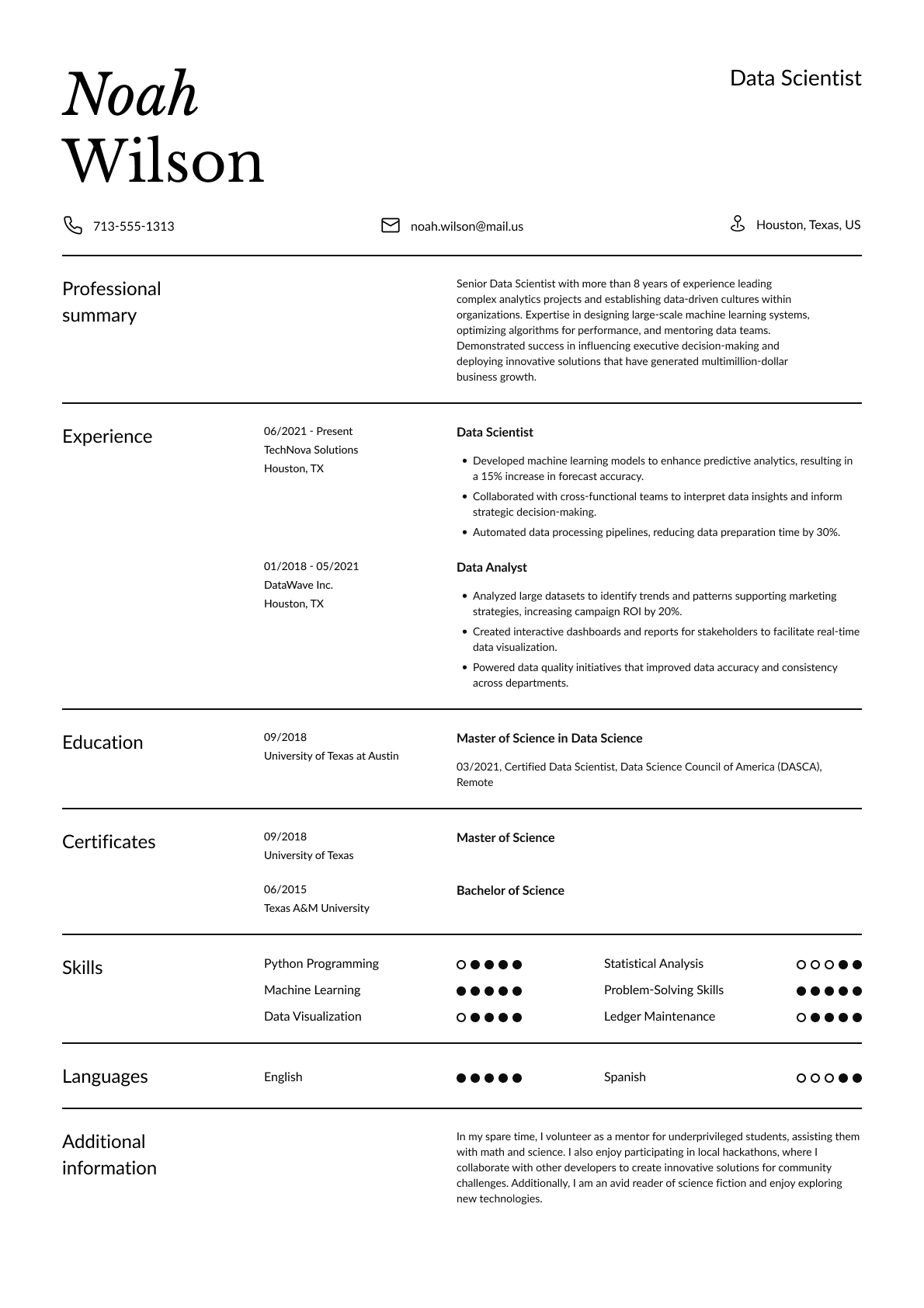
Noah Wilson
Data Scientist
noah.wilson@mail.us 7135551313 Houston, Texas, US
Profile
Senior Data Scientist with more than 8 years of experience leading complex analytics projects and establishing data-driven cultures within organizations. Expertise in designing large-scale machine learning systems, optimizing algorithms for performance, and mentoring data teams. Demonstrated success in influencing executive decision-making and deploying innovative solutions that have generated multimillion-dollar business growth.
Work Experience
06/2021 - Present, Data Scientist, TechNova Solutions, Houston, TX
- Developed machine learning models to enhance predictive analytics, resulting in a 15% increase in forecast accuracy.
- Collaborated with cross-functional teams to interpret data insights and inform strategic decision-making.
- Automated data processing pipelines, reducing data preparation time by 30%.
01/2018 - 05/2021, Data Analyst, DataWave Inc., Houston, TX
- Analyzed large datasets to identify trends and patterns supporting marketing strategies, increasing campaign ROI by 20%.
- Created interactive dashboards and reports for stakeholders to facilitate real-time data visualization.
- Powered data quality initiatives that improved data accuracy and consistency across departments.
08/2014 - 12/2017, Junior Data Analyst, Quantify Analytics, Houston, TX
- Supported senior staff in data collection, cleaning, and analysis for client projects.
- Developed scripts to automate repetitive data tasks, saving approximately 10 hours weekly.
- Conducted exploratory data analysis to assist in model development and validation.
Education
09/2018, Master of Science in Data Science, University of Texas at Austin, Austin
06/2015, Bachelor of Science in Computer Science, Texas A&M University, College Station
03/2021, Certified Data Scientist, Data Science Council of America (DASCA), Remote
Skills
- Python Programming
- Machine Learning
- Data Visualization
- Statistical Analysis
- Problem-Solving Skills
How to write a data scientist resume
Before writing, understand what your data scientist resume must contain. Key sections typically include:
- Profile
- Work Experience
- Education
- Skills
Your resume should reflect the distinctive expertise you bring as a data scientist. Begin by researching the company and role to tailor your application precisely. Identify the organization's challenges and demonstrate how your data science skills address those needs. Follow these guidelines for an effective resume:
- Focus on your achievements and impact, not just responsibilities. Specific results highlight your value.
- Customize your resume for each position, matching tone and style to the employer.
- Present a professional yet engaging image using a polished resume template.
- Incorporate relevant keywords to ensure your accomplishments are clearly recognized by recruiters and applicant tracking systems.
Choosing the right resume format for data science
Your resume should be clear, professional, and easy to navigate—qualities that mirror an excellent data scientist.
The reverse chronological format is generally best. It highlights your most recent roles first, then works backward through your career history.
For those transitioning from other fields or with diverse experiences, a functional format emphasizing skills over employers may be advantageous. Alternatively, a hybrid format combines chronology with skills focus.
Explore resume templates in our builder and pick the format that suits your unique background. Many examples in each style are available.
Choose a clean, modern, and professional layout for your data scientist resume to reinforce your expertise.
Include your contact information
The resume header is vital for clearly identifying who you are and how to reach you—make this prominent and professional.
Essential information includes:
- Your full name
- Your professional email address
- Your phone number
- Your LinkedIn profile (optional but recommended)
Avoid including:
- Your full home address
- Unnecessary personal details
Make use of a summary
Data science is often viewed as highly technical, but your resume summary offers a chance to showcase your individual approach and personality. This section humanizes your profile and dispels the notion that data scientists are solely number crunchers.
Consider your summary as a narrative blending your technical expertise with your problem-solving style and achievements. Unlike other sections where bullet points dominate, your summary allows for more expressive language.
Use dynamic verbs, clear statements, and positive phrasing to let your character emerge. Avoid simply rephrasing your resume content; instead, provide overarching insights about who you are professionally.
Below are adaptable summary/profile examples tailored for data scientists at various career stages:
Entry-level adaptable resume summary/profile example
Recent data science graduate with a strong foundation in statistical analysis, machine learning, and data visualization. Eager to apply academic knowledge to real-world data challenges and develop new analytical skills. Demonstrates a proactive learning attitude and effective teamwork in project settings. Passionate about leveraging data to inform business decisions and drive innovation.
Mid-level adaptable resume summary/profile example
Data Scientist with over 4 years of experience in data analysis, model development, and predictive analytics across various industries. Proven ability to develop and implement machine learning models that increased predictive accuracy by up to 30%, resulting in significant cost savings. Skilled in Python, R, SQL, and Tableau, with a strong track record of delivering actionable insights that support strategic objectives.
Senior adaptable resume summary/profile example
Senior Data Scientist with more than 8 years of experience leading complex analytics projects and establishing data-driven cultures within organizations. Expertise in designing large-scale machine learning systems, optimizing algorithms for performance, and mentoring data teams. Demonstrated success in influencing executive decision-making and deploying innovative solutions that have generated multimillion-dollar business growth.
Outline your data science work experience
Following a reverse chronological order, start with your current or most recent position and work backward. Limit your detailed work history to the past 10-15 years to maintain relevance and avoid potential unconscious bias.
Include only experience pertinent to the data scientist role you want. Other experiences might be listed under a separate "Other Experience" section.
Under each job title and employer, describe your contributions and successes in concise, specific bullet points. Avoid personal pronouns; begin each statement with impactful action verbs such as designed, developed, optimized, or analyzed.
Go beyond listing duties by illustrating concrete outcomes—quantify your impact where possible. Specificity makes your resume compelling and breaks the stereotype of generic data roles.
Generic examples might read:
- Handled data preprocessing and analysis
- Built predictive models for company projects
- Presented data reports to stakeholders
These are vague; enhanced versions could be:
- Developed data preprocessing pipelines improving data quality by 30% for a customer churn prediction project
- Built and deployed machine learning models increasing prediction accuracy by 15%, directly contributing to revenue growth
- Generated automated dashboards delivering real-time insights to stakeholders, reducing reporting time by 50%
Review the data scientist work history resume sample below for guidance:
Data Scientist employment history resume sample
06/2021 - Present, Data Scientist, TechNova Solutions, Houston, TX
- Developed machine learning models to enhance predictive analytics, resulting in a 15% increase in forecast accuracy.
- Collaborated with cross-functional teams to interpret data insights and inform strategic decision-making.
- Automated data processing pipelines, reducing data preparation time by 30%.
01/2018 - 05/2021, Data Analyst, DataWave Inc., Houston, TX
- Analyzed large datasets to identify trends and patterns supporting marketing strategies, increasing campaign ROI by 20%.
- Created interactive dashboards and reports for stakeholders to facilitate real-time data visualization.
- Powered data quality initiatives that improved data accuracy and consistency across departments.
08/2014 - 12/2017, Junior Data Analyst, Quantify Analytics, Houston, TX
- Supported senior staff in data collection, cleaning, and analysis for client projects.
- Developed scripts to automate repetitive data tasks, saving approximately 10 hours weekly.
- Conducted exploratory data analysis to assist in model development and validation.
Include the relevant key skills
Data science emphasizes technical hard skills, which usually compose most of your resume content. Still, incorporating soft skills demonstrates your ability to collaborate and adapt.
Hard skills include proficiency with programming languages like Python or R, expertise in machine learning frameworks, data wrangling, and statistical analysis. Soft skills might cover communication, problem-solving, and teamwork.
Keep your skills section focused and tailored to the job description. Maintain a master list of your competencies, update it regularly, and select the most appropriate skills for each application.
Use our resume builder’s selection of pre-written key skills or add your own to fit your profile.
Here’s an example skills section from our data scientist resume template:
Data Scientist key skills resume sample
- Python Programming
- Machine Learning
- Data Visualization
- Statistical Analysis
- Problem-Solving Skills
Detail your education & certifications
The education section showcases your academic and professional credentials that qualify you as a data scientist. Most data scientists hold a degree in computer science, statistics, mathematics, or a related field, often complemented by advanced degrees.
It's generally unnecessary to list high school education if you have higher education credentials. Focus on relevant degrees, certifications, and training, such as:
- Degrees in data science, computer science, statistics, or engineering
- Professional certifications like Certified Analytics Professional (CAP), Google Data Analytics Certificate, or Microsoft Certified: Azure Data Scientist Associate
- Workshops and specialized courses in machine learning, deep learning, or big data technologies
- Internships or research projects, especially for those early in their careers
Data Scientist education & certifications resume sample
09/2018, Master of Science in Data Science, University of Texas at Austin, Austin
06/2015, Bachelor of Science in Computer Science, Texas A&M University, College Station
03/2021, Certified Data Scientist, Data Science Council of America (DASCA), Remote
Pick the right resume layout and design
The layout, design, and formatting set the tone and guide recruiters' focus on your data scientist resume. These elements create the crucial first impression.
A clean, modern, and professional design is ideal. Data scientists are associated with analytical rigor, innovation, and precision, and your resume should visually communicate these traits.
Consider how different formats reflect your professional profile. For conventional roles, a straightforward design suffices; for innovative teams, a more contemporary or creative style might be effective.
Browse our expertly designed templates to streamline your resume creation with well-crafted structure and formatting.
Data Scientist job market and outlook
Data science is a rapidly growing field with strong demand. According to the U.S. Bureau of Labor Statistics, employment for data scientists is projected to grow 36% from 2021 to 2031, much faster than the average for all occupations.
This growth is fueled by increased data generation and companies’ need to leverage analytics for decision-making and competitive advantage.
The median annual salary for data scientists is approximately $100,000, with the highest 10% earning over $160,000, reflecting the high value of this expertise.
The favorable job market signals a robust future for data scientists as organizations continue investing in data-driven strategies.
Exceptional earning potential and satisfying career opportunities make data science a compelling career choice.
Key takeaways
Data science is among the fastest-growing professions, with an anticipated 36% job growth over the next decade, reflecting rising demand for data expertise.
Employers seek data scientists who combine technical skills with the ability to translate data into business value.
Salaries are highly competitive, with median earnings around $100,000 and significant upside for top performers.
Your resume should emphasize measurable achievements, relevant technical abilities, and a polished professional presentation.
Embracing these strategies increases your chances of success in the dynamic and rewarding field of data science.
