
Every community depends on skilled firefighters, and every firefighter resume that catches the eye of a fire department's hiring team must stand out on several critical fronts.
Firefighters know that courage, quick decision-making, and rigorous training are essential for the job, and the same level of care should be applied when crafting your resume. Your resume is often the first impression you make on a fire chief or recruitment officer, so it must be clear, professional, and showcase your qualifications effectively.
Resume guide for a firefighter resume
Fitly here to help. Our resume builder and field-tested resume examples across more than 500 professions empower you to stay competitive in your quest for a rewarding firefighter career. This resume guide alongside the firefighter resume example will explore the following key topics:
- Selecting the most effective resume format for firefighting roles
- How to present your contact information clearly
- The value of a compelling summary statement
- Detailing your firefighting experience
- Highlighting the essential skills for firefighters
- Showcasing your education & certifications
- Choosing the appropriate layout and design for your firefighter resume
Let's get started!
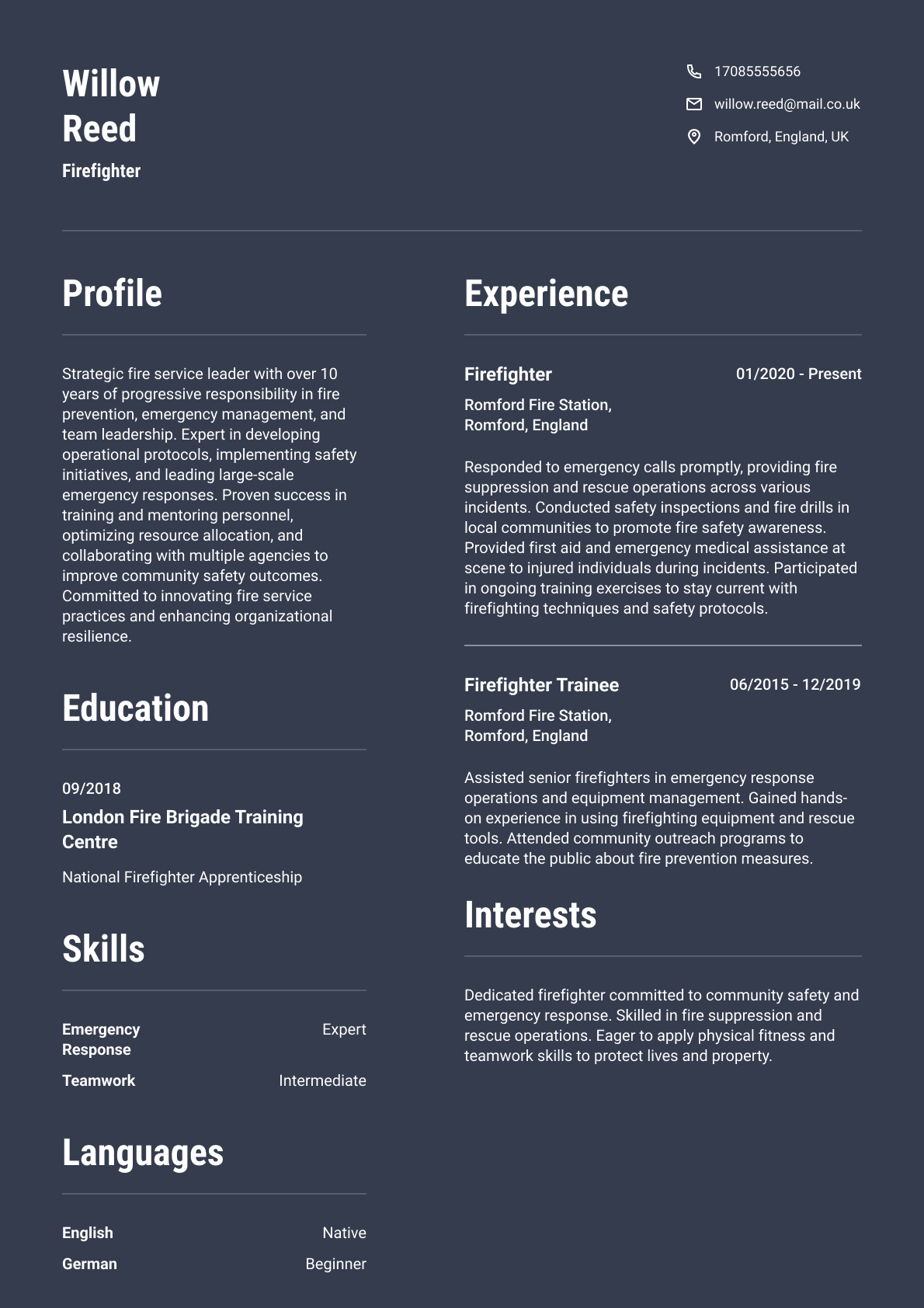
Resume example (text format)
Willow Reed
Firefighter
willow.reed@mail.co.uk 17085555656 Romford, England, UK
Profile
Strategic fire service leader with over 10 years of progressive responsibility in fire prevention, emergency management, and team leadership. Expert in developing operational protocols, implementing safety initiatives, and leading large-scale emergency responses. Proven success in training and mentoring personnel, optimizing resource allocation, and collaborating with multiple agencies to improve community safety outcomes. Committed to innovating fire service practices and enhancing organizational resilience.
Work Experience
01/2020 - Present, Firefighter, Romford Fire Station, Romford, England, UK
- Responded to emergency calls promptly, providing fire suppression and rescue operations across various incidents.
- Conducted safety inspections and fire drills in local communities to promote fire safety awareness.
- Provided first aid and emergency medical assistance at scene to injured individuals during incidents.
- Participated in ongoing training exercises to stay current with firefighting techniques and safety protocols.
06/2015 - 12/2019, Firefighter Trainee, Romford Fire Station, Romford, England, UK
- Assisted senior firefighters in emergency response operations and equipment management.
- Gained hands-on experience in using firefighting equipment and rescue tools.
- Attended community outreach programs to educate the public about fire prevention measures.
09/2012 - 05/2015, Junior Firefighter, Romford Fire Station, Romford, England, UK
- Supported daily station activities including equipment maintenance and storage.
- Participated in fire safety training sessions to develop foundational firefighting skills.
Education
09/2018, National Firefighter Apprenticeship, London Fire Brigade Training Centre, London, UK
06/2015, Emergency Response and Rescue Certification, UK Emergency Response Academy, London, UK
07/2010, Basic Firefighting and Rescue Training, East London Fire Brigade Training School, London, UK
Skills
- Emergency Response
- Fire Suppression Techniques
- Crisis Management
- Physical Fitness
- Teamwork
How to write a firefighter resume
Before beginning, it’s vital to understand what your firefighter resume should include to demonstrate your qualifications. Here are the essential sections:
- Profile
- Work Experience
- Education
- Skills
Your resume should communicate what makes you a reliable and skilled firefighter. Start by researching the fire department and understanding the demands of the role. Aim to present yourself as the ideal candidate equipped to respond effectively to emergencies. Follow this approach:
- Emphasize your accomplishments in fire safety, rescue operations, and emergency response — not just your routine responsibilities.
- Customize your resume for every application, tailoring language and focus to the employer's expectations.
- Create a professional yet approachable impression with a clear, well-structured resume template.
- Incorporate relevant fire service terminology and keywords that will resonate with both human readers and automated applicant tracking systems.
Choosing the right resume format for firefighting
Your firefighter resume should be clean, professional, and easy to navigate — traits reflecting the discipline and reliability vital in firefighting.
The reverse chronological format is usually the best choice. It highlights your most recent firefighting experience first, then works backward through your earlier roles.
If you are changing careers or have diverse experiences, a functional format emphasizing your skills may be beneficial. Alternatively, a hybrid format that combines chronological and skills-based elements can also be effective.
Explore various resume templates within our builder and pick the one that best suits your background. Numerous examples of each format are available to inspire you.
Choose a layout that supports a straightforward and professional image, reinforcing your brand as a dependable firefighter.
Include your contact information
The resume header should clearly answer whose resume this is and how to reach you. It must be both accessible and professionally presented.
Include:
- Your full name
- Your professional email address
- Your phone number
- Your LinkedIn or professional profile (if applicable)
Avoid including:
- Your full home address
- Personal details like marital status or age
Make use of a summary
Firefighting is known for its physical and mental demands, but your firefighter resume summary is your opportunity to convey dedication, resilience, and teamwork skills that set you apart.
Think of your summary as a brief narrative highlighting your firefighting expertise and your approach to high-pressure situations. Unlike typical bullet sections, the summary allows for a more dynamic expression of your professional identity.
Utilize powerful action words, positive phrasing, and a tone that reflects your commitment to protecting the community. Avoid simply restating resume details; instead, provide an overview of your strengths and motivations.
Below are adaptable firefighter resume summary examples for various experience levels:
Entry-level adaptable resume summary/profile example
Motivated and dedicated entry-level firefighter with a strong passion for community safety and emergency response. Possesses solid knowledge of fire prevention techniques and basic rescue operations through rigorous training and certification. Eager to apply my physical fitness, teamwork skills, and quick decision-making abilities to protect lives and property. Committed to ongoing learning and professional growth in fire service excellence.
Mid-level adaptable resume summary/profile example
Experienced firefighter with over 4 years of field expertise in emergency response, fire suppression, and rescue operations. Demonstrated ability to efficiently manage fire scenes, conduct thorough safety assessments, and support community outreach programs. Skilled in equipment operation, incident command, and first aid, with a proven track record of reducing response times and enhancing team effectiveness. Adept at training new personnel and contributing to departmental safety protocols.
Senior adaptable resume summary/profile example
Strategic fire service leader with over 10 years of progressive responsibility in fire prevention, emergency management, and team leadership. Expert in developing operational protocols, implementing safety initiatives, and leading large-scale emergency responses. Proven success in training and mentoring personnel, optimizing resource allocation, and collaborating with multiple agencies to improve community safety outcomes. Committed to innovating fire service practices and enhancing organizational resilience.
Outline your firefighting work experience
Using a reverse chronological approach, list your most recent firefighting or related emergency services roles first, working back no more than 10-15 years to keep your resume focused and relevant.
Include only experience pertinent to firefighting or emergency response. For other roles, consider an “Other Experience” section if necessary.
For each job, list your key responsibilities and achievements using concise bullet points. Omit personal pronouns; begin each bullet with strong action verbs like responded, trained, maintained, coordinated, or rescued.
Don’t just list duties — highlight measurable outcomes and contributions. Quantifying your impact strengthens your resume and demonstrates your effectiveness on the fireground.
Generic bullets like these miss the mark:
- Conducted fire suppression and rescue operations
- Performed equipment maintenance
- Supported community safety programs
Now compare to stronger, more specific examples:
- Led over 50 emergency fire suppression operations with zero casualty outcomes
- Maintained firefighting equipment to ensure 100% readiness for all shifts
- Developed and delivered fire prevention education that improved community awareness by 30%
Check out the firefighter employment history resume sample below for inspiration:
Firefighter employment history resume sample
01/2020 - Present, Firefighter, Romford Fire Station, Romford, England, UK
- Responded to emergency calls promptly, providing fire suppression and rescue operations across various incidents.
- Conducted safety inspections and fire drills in local communities to promote fire safety awareness.
- Provided first aid and emergency medical assistance at scene to injured individuals during incidents.
- Participated in ongoing training exercises to stay current with firefighting techniques and safety protocols.
06/2015 - 12/2019, Firefighter Trainee, Romford Fire Station, Romford, England, UK
- Assisted senior firefighters in emergency response operations and equipment management.
- Gained hands-on experience in using firefighting equipment and rescue tools.
- Attended community outreach programs to educate the public about fire prevention measures.
09/2012 - 05/2015, Junior Firefighter, Romford Fire Station, Romford, England, UK
- Supported daily station activities including equipment maintenance and storage.
- Participated in fire safety training sessions to develop foundational firefighting skills.
Include the relevant key skills
Firefighting requires a mix of technical hard skills and collaborative soft skills. Most firefighter resumes consist largely of hard skills, but soft skills provide an important balance that shows your ability to perform under pressure while working as a team.
Hard skills include proficiency with firefighting tools, extensive knowledge of fire safety protocols, emergency medical response, hazard assessment, and physical fitness. Soft skills encompass teamwork, adaptability, effective communication, stress management, and decision-making under pressure.
Customize your skills section to highlight the qualifications most important for your targeted firefighter role. Keep a master list handy and select the most relevant skills for each version of your resume.
Our resume builder includes a selection of essential firefighter skills you can easily incorporate, along with options to add your own.
The skills section in our firefighter resume template typically looks like this:
Firefighter key skills resume sample
- Emergency Response
- Fire Suppression Techniques
- Crisis Management
- Physical Fitness
- Teamwork
Detail your education & certifications
Your education section should highlight academic achievements and credentials essential to firefighting. Fire departments expect candidates to have relevant formal training, often including fire academy completion and ongoing professional development.
If you possess a high school diploma or GED, that is a basic requirement. Advanced education in fire science, emergency medical services, or related fields can be a plus.
Include certifications such as:
- Firefighter I and II certifications
- Emergency Medical Technician (EMT) or Paramedic licenses
- Hazardous Materials (HAZMAT) training
- CPR and First Aid certifications
- Leadership training courses and relevant fire safety seminars
Firefighter education & certifications resume sample
09/2018, National Firefighter Apprenticeship, London Fire Brigade Training Centre, London, UK
06/2015, Emergency Response and Rescue Certification, UK Emergency Response Academy, London, UK
07/2010, Basic Firefighting and Rescue Training, East London Fire Brigade Training School, London, UK
Pick the right resume layout and design
The design and organization of your firefighter resume are crucial for making a strong first impression on recruiters and fire chiefs. A clean, well-laid-out resume demonstrates your professionalism and attention to detail.
A classic, straightforward layout reinforces the values of discipline, reliability, and readiness associated with firefighting. Be mindful that overly flashy or creative designs could detract from the serious nature of the profession.
Consider the expectations of the fire department you are applying to and select a template that aligns with those standards. Our collection of tested firefighter resume templates can help you present yourself effectively.
Firefighter job market and outlook
The firefighting profession continues to be essential and is projected to experience steady demand due to community safety needs and emergency response demands.
According to the U.S. Bureau of Labor Statistics, firefighter employment is expected to grow about 6% from 2021 to 2031, faster than the average for all occupations.
Salary ranges vary by location and experience, but the median annual wage for firefighters is approximately $50,700, with top earners making over $90,000 per year.
Firefighters with advanced certifications, EMT training, and leadership skills often have better job prospects and advancement opportunities.
The profession’s growth is influenced by increased awareness for fire prevention and emergency preparedness measures across communities.
Key takeaways
Firefighting is a vital, respected career with steady demand nationwide. The job market is growing steadily, fueled by the continuous need for public safety and emergency response.
Strong qualifications, including relevant certifications and documented experience, improve your competitiveness in this field.
Your resume should emphasize your hands-on skills, team collaboration, and your commitment to protecting lives and property.
A well-crafted resume tailored to each fire department's requirements will help you stand out and put you one step closer to your dream firefighting role.
Stay prepared, keep training, and present yourself confidently through your resume to secure a rewarding future as a firefighter.
