
Every library relies on a skilled librarian, and every librarian resume that aims to impress potential employers must meet several key criteria.
Librarians understand the importance of organization, research, and information management, and these qualities are equally crucial when crafting an effective resume. Your resume is your first opportunity to show hiring managers your capability and professionalism, so making it stand out is essential.
Resume guide for a librarian resume
Fitly here to help. Our resume builder and field-tested resume examples for over 500 professions will give you the advantage to stay ahead in your pursuit of a dream librarian job. This resume guide and corresponding librarian resume example will cover the following topics:
- Choosing the right resume format for librarianship
- Include your contact information
- Make use of a summary
- Outline your librarian work experience
- Include the relevant key skills
- Detail your education & certifications
- Pick the right resume layout and design
Let's dive in!
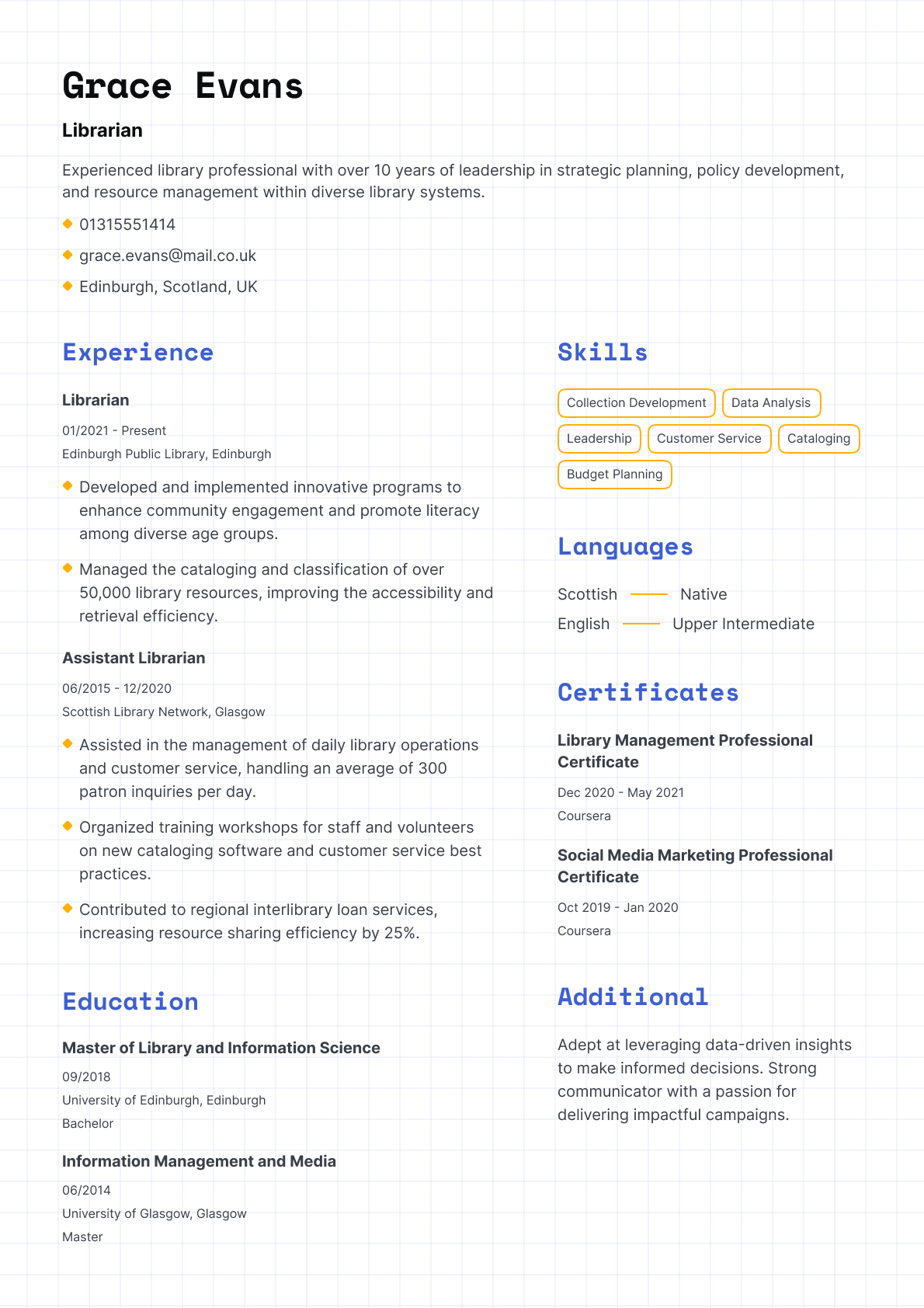
Resume example (text format)
Grace Evans
Librarian
grace.evans@mail.co.uk 01315551414 Edinburgh, Scotland, UK
Profile
Experienced library professional with over 10 years of leadership in strategic planning, policy development, and resource management within diverse library systems. Demonstrates a strong ability to lead teams, develop innovative services, and align library objectives with organizational goals. Expert in digital transformation, community outreach, and fostering partnerships to expand resource accessibility. Committed to advancing library services through data-driven decision-making and sustainable practices.
Work Experience
01/2021 - Present, Librarian, Edinburgh Public Library, Edinburgh, Scotland, UK
- Developed and implemented innovative programs to enhance community engagement and promote literacy among diverse age groups.
- Managed the cataloging and classification of over 50,000 library resources, improving the accessibility and retrieval efficiency.
- Led digital transformation initiatives, integrating e-books and online resources, resulting in a 30% increase in digital loan circulation.
06/2015 - 12/2020, Assistant Librarian, Scottish Library Network, Glasgow, Scotland, UK
- Assisted in the management of daily library operations and customer service, handling an average of 300 patron inquiries per day.
- Organized training workshops for staff and volunteers on new cataloging software and customer service best practices.
- Contributed to regional interlibrary loan services, increasing resource sharing efficiency by 25%.
Education
09/2018, Master of Library and Information Science, University of Edinburgh, Edinburgh, UK
06/2014, Bachelor of Information Management and Media, University of Glasgow, Glasgow, UK
Skills
- Collection Development
- Cataloging and Classification
- Information Literacy Instruction
- Customer Service
- Technology Skills
How to write a librarian resume
Before you get started, you need to know what your librarian resume should include. Here are the necessary sections:
- Profile
- Work Experience
- Education
- Skills
Your resume should reflect the unique expertise you bring as a librarian. To start, gather as much information as possible about the library and role to which you're applying. Understand the institution’s needs and plan to showcase how you are exactly the right librarian to enhance their collection and services. To do this well, stick to this formula:
- Highlight your accomplishments, not just your job duties. Anyone can list the tasks they were assigned, but showcasing your specific achievements will prove your value.
- Tailor your resume for each application you submit by adjusting the style and tone to match that of the employer.
- Convey a professional, streamlined image with a resume template that's polished, not stuffy or overly formal.
- Include relevant keywords to make sure the reader or system can understand exactly what you've accomplished.
Choosing the right resume format for librarianship
Your resume should be clear, professional, and easy to navigate — much like a well-organized library catalog.
While there are different resume formats, the reverse chronological format is often the best choice. It puts your most recent librarian experience first, moving backward through your career.
If you are transitioning careers or have a diverse background, a functional format focusing on skills and expertise rather than job titles might be ideal. Alternatively, a hybrid resume combining chronological and functional elements can work well.
Explore the resume templates in our resume builder and pick the format that fits your situation best. There are numerous versions of each format offered as resume examples too.
Be sure to apply a clean, modern, or professional layout for your librarian resume to reflect your professional image.
Include your contact information
Your resume header should clearly present your identity and the best ways to reach you. This information needs to be accessible and professionally presented.
Typical details to include are:
- Your full name
- Your professional email address
- Your phone number
- Your LinkedIn profile or professional portfolio link (if applicable)
Details to avoid including:
- Your home address
- Personal information irrelevant to the job
Make use of a summary
Librarianship is a specialized field, but your librarian resume summary is an opportunity to add personality and convey your passion for knowledge management and service. It offers a chance to dispel any misconceptions about librarians as only caretakers of books, highlighting instead your dynamic role in facilitating access to information and supporting learning.
Consider your librarian resume summary as a narrative of your professional expertise and interpersonal skills. This section is one of the few places on your resume that allows more creative expression, while the remainder typically follows bullet-point formats.
Use energetic language, strong action verbs, and positive statements. Let your character shine. Avoid repeating your work history in different words; instead, provide overarching themes about your approach, skills, and achievements.
Below, you'll find adaptable librarian resume summary examples:
Entry-level adaptable resume summary/profile example
Recent library science graduate with a strong academic background and a passion for information organization and community engagement. Eager to apply foundational skills in cataloging, research assistance, and customer service in a dynamic library setting. Demonstrates excellent communication abilities and a commitment to helping patrons find resources efficiently. Enthusiastic about developing professional skills and contributing to organizational goals.
Mid-level adaptable resume summary/profile example
Mid-career librarian with over 4 years of experience in academic and public library environments. Proven track record of improving cataloging processes, increasing patron engagement through educational programs, and managing digital resources efficiently. Skilled in reference services, collection development, and using library management systems such as Koha and Sierra. Adept at coordinating team efforts and implementing new initiatives that enhance library services and user satisfaction.
Senior adaptable resume summary/profile example
Experienced library professional with over 10 years of leadership in strategic planning, policy development, and resource management within diverse library systems. Demonstrates a strong ability to lead teams, develop innovative services, and align library objectives with organizational goals. Expert in digital transformation, community outreach, and fostering partnerships to expand resource accessibility. Committed to advancing library services through data-driven decision-making and sustainable practices.
Outline your librarian work experience
Using the reverse chronological format, list your most recent librarian position first, then work backward through your employment history. Limit your work experience to the last 10-15 years for relevance and to avoid age bias.
Include only roles directly related to librarianship or information management. You may create a separate section for "Other Experience" if needed to include additional work history.
Under each job title and employer, describe your contributions and successes using concise, specific bullet points. Avoid personal pronouns like "I" or "my." Begin each point with impactful action verbs such as coordinated, cataloged, researched, managed, or facilitated.
Don’t simply list duties; instead, highlight measurable outcomes and achievements. Including quantifiable data provides concrete evidence of your impact and helps your resume stand out.
Here are weak examples anyone might write:
- Managed library collection and resources
- Assisted patrons with research and inquiries
- Processed check-outs and returns
Now see how these can be improved with added specificity and results:
- Coordinated the cataloging and digitization of over 10,000 items, improving accessibility for patrons
- Assisted over 200 library visitors weekly with research support, enhancing user satisfaction scores by 15%
- Streamlined circulation processes, reducing wait times by 20% through system improvements
Review the sample librarian employment history example below:
Librarian employment history resume sample
01/2021 - Present, Librarian, Edinburgh Public Library, Edinburgh, Scotland, UK
- Developed and implemented innovative programs to enhance community engagement and promote literacy among diverse age groups.
- Managed the cataloging and classification of over 50,000 library resources, improving the accessibility and retrieval efficiency.
- Led digital transformation initiatives, integrating e-books and online resources, resulting in a 30% increase in digital loan circulation.
06/2015 - 12/2020, Assistant Librarian, Scottish Library Network, Glasgow, Scotland, UK
- Assisted in the management of daily library operations and customer service, handling an average of 300 patron inquiries per day.
- Organized training workshops for staff and volunteers on new cataloging software and customer service best practices.
- Contributed to regional interlibrary loan services, increasing resource sharing efficiency by 25%.
Include the relevant key skills
Librarianship requires a strong blend of technical and interpersonal skills. About 80-90% of your resume should highlight hard skills such as cataloging systems, database management, and research techniques. Soft skills like communication, organization, critical thinking, and adaptability are equally important to demonstrate your comprehensive capabilities.
Your librarian resume should be concise and tailored to the specific role. Maintain a master list of your skills and update it regularly. Then, choose the most relevant skills to highlight for each application based on the job description.
Our resume builder offers a variety of pre-written key skills for librarians, but you can also add any unique abilities that set you apart.
Here is an example of the skills section in our librarian resume template:
Librarian key skills resume sample
- Collection Development
- Cataloging and Classification
- Information Literacy Instruction
- Customer Service
- Technology Skills
Detail your education & certifications
The education section of your resume highlights the academic foundation supporting your skills as a librarian. Most librarian roles require at least a bachelor's degree, often in library science, information studies, or a related field, with many professionals holding a Master of Library Science (MLS) or Master of Information Science (MIS).
If you have a graduate degree, listing your high school education is unnecessary. Be sure to include relevant certifications and training, such as:
- Professional librarian certifications or licensure specific to your region or institution
- Courses on digital librarianship, archival studies, cataloging standards (e.g. MARC, RDA), or information technology
- Memberships in professional associations like the American Library Association (ALA)
- Internships or practicum experiences if you are an entry-level candidate
Librarian education & certifications resume sample
09/2018, Master of Library and Information Science, University of Edinburgh, Edinburgh, UK
06/2014, Bachelor of Information Management and Media, University of Glasgow, Glasgow, UK
Pick the right resume layout and design
A clean, well-structured layout and thoughtful design make your librarian resume visually appealing and easy to review. These elements create a positive first impression for hiring managers and set you apart from other candidates.
Librarians are viewed as detail-oriented, organized, and approachable. Your resume design should reflect these qualities through a balanced, professional, and uncluttered format.
Before settling on a template, consider what your chosen format communicates about your candidacy. For formal librarian roles, simplicity and clarity are key, but a tasteful modern design might suit certain institutions.
Explore our curated resume templates where the most detailed structure and formatting are already taken care of for you.
Librarian job market and outlook
The librarian profession remains steady with consistent demand for skilled information professionals. According to the U.S. Bureau of Labor Statistics, employment of librarians is projected to grow about 6% from 2021 to 2031, which is about as fast as the average for all occupations.
Demand is driven by the need to organize digital data, support community education, and manage evolving information resources across diverse environments.
The median annual salary for librarians is approximately $60,820, with top earners exceeding $90,000 per year, depending on experience and location.
Overall, the librarian job market remains competitive but promising, especially for candidates with technology and digital resource management skills.
Key takeaways
Information management is an ever-important field, with steady demand for knowledgeable librarians who can navigate both traditional and digital resources.
The librarian job market is expected to grow steadily, driven by changing information landscapes and community needs.
The average annual salary for librarians is around $60,820, with the potential to earn more at senior levels or specialized positions.
A well-crafted and tailored librarian resume, emphasizing both your technical skills and passion for service, will give you a competitive edge.
Staying current with technology and trends in information science is key to advancing in this profession.
