
Every thriving marine research initiative depends on the expertise of a skilled marine biologist, and your marine biologist resume must stand out to captivate prospective employers.
Marine biologists understand that careful observation and meticulous data collection are critical to success, and the same principles apply when crafting a compelling resume. Your resume acts as your initial introduction to hiring committees, so it is vital to present yourself at your best.
Resume guide for a marine biology resume
We're here to assist. Our resume builder and thoroughly tested resume examples across numerous careers will empower you to excel in your quest for the ideal marine biologist position. This guide and the marine biologist resume example will walk you through essential topics such as:
- Selecting the optimal resume format for marine biology
- Including clear contact information
- Crafting an impactful summary
- Detailing your marine biology work experience
- Highlighting relevant key skills
- Presenting your education and certifications
- Choosing the perfect resume layout and design
Let’s dive in!
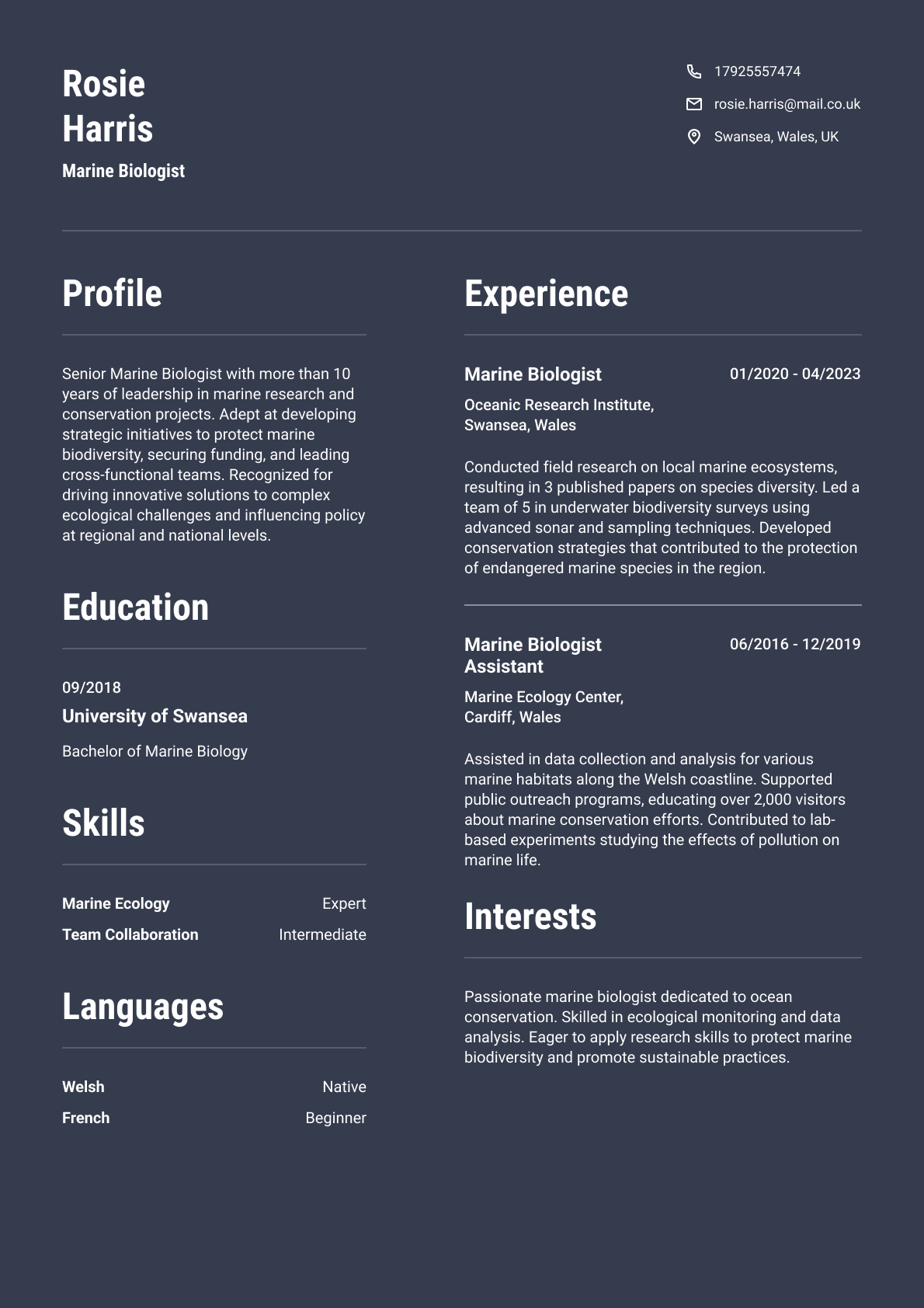
Resume example (text format)
Rosie Harris
Marine Biologist
rosie.harris@mail.co.uk 17925557474 Swansea, Wales, UK
Profile
Senior Marine Biologist with more than 10 years of leadership in marine research and conservation projects. Adept at developing strategic initiatives to protect marine biodiversity, securing funding, and leading cross-functional teams. Recognized for driving innovative solutions to complex ecological challenges and influencing policy at regional and national levels.
Work Experience
01/2020 - 04/2023, Marine Biologist, Oceanic Research Institute, Swansea, Wales
- Conducted field research on local marine ecosystems, resulting in 3 published papers on species diversity.
- Led a team of 5 in underwater biodiversity surveys using advanced sonar and sampling techniques.
- Developed conservation strategies that contributed to the protection of endangered marine species in the region.
06/2016 - 12/2019, Marine Biologist Assistant, Marine Ecology Center, Cardiff, Wales
- Assisted in data collection and analysis for various marine habitats along the Welsh coastline.
- Supported public outreach programs, educating over 2,000 visitors about marine conservation efforts.
- Contributed to lab-based experiments studying the effects of pollution on marine life.
09/2013 - 05/2016, Research Fellow, University of Swansea, Swansea, Wales
- Worked on a funded project examining the impact of climate change on local coral reef systems.
- Published findings in peer-reviewed journals, enhancing university research visibility.
Education
09/2018, Bachelor of Marine Biology, University of Swansea, Swansea, Wales
06/2020, MSc Marine Conservation and Policy, University of Exeter, Exeter, Devon
11/2021, Certified Marine Biodiversity Professional (CMBP), Society for Marine Biology, London
Skills
- Marine Ecology
- Sample Collection and Identification
- Data Analysis and Interpretation
- Scientific Writing and Communication
- Team Collaboration
How to write a marine biology resume
Before you begin, understand the crucial sections your marine biologist resume should encompass. These include:
- Profile
- Work Experience
- Education
- Skills
Your resume should showcase the unique expertise you bring as a marine biologist. Begin by thoroughly researching the organization and position you are targeting. Identify their specific needs and demonstrate how you are the perfect marine biologist to advance their mission. To achieve this effectively, follow these guidelines:
- Emphasize your accomplishments rather than just listing duties. Everyone can enumerate tasks, but highlighting your specific contributions illustrates your true value.
- Customize your resume for each application by aligning your style and tone with the employer’s culture and expectations.
- Project a professional, polished image through a streamlined resume template that is approachable yet authoritative.
- Incorporate pertinent keywords to ensure both recruiters and applicant tracking systems recognize your expertise and accomplishments.
Choosing the right resume format for marine biology
Your resume should be clear, professional, and easy to navigate—the same qualities essential in a marine biologist’s work.
Among various formats, the reverse chronological layout is preferred. It highlights your most recent positions first, then chronicles earlier roles.
If you are transitioning careers or possess a diverse background, the functional format, which prioritizes skills over job titles, can be advantageous. Alternatively, a hybrid format blends chronological and functional elements effectively.
Explore our resume templates to find the one that fits your experience and goals. Numerous example resumes are available to guide your choice.
Make sure to select a clean, modern, and professional layout to reflect your marine biology expertise.
Include your contact information
The header of your resume should clearly identify whose document it is and provide straightforward ways to get in touch with you. Keep this section accessible and professional.
Essential contact details include:
- Your full name
- Your email address
- Your phone number
- Your LinkedIn profile or professional website (if applicable)
Omit personal details such as:
- Home address
- Other private information
Utilize a compelling summary
Marine biology is a scientific field, yet your resume summary offers a prime opportunity to infuse some personality and convey your passion for marine ecosystems. This section, occasionally labeled a profile, adds a crucial human element to your resume.
Think of your marine biologist summary as a brief narrative of your skills and character. It offers a chance to differentiate yourself beyond bullet points while still maintaining professionalism.
Use vibrant language, dynamic action verbs, and positive declarations that reflect your drive and expertise. Avoid redundancy by not simply rephrasing information already included elsewhere. Instead, deliver insights into your approach, achievements, and professional values.
Below are adaptable marine biologist resume summaries you can tailor as needed:
Entry-level adaptable resume summary/profile example
Motivated Marine Biologist with a strong academic foundation in marine ecology and environmental science. Eager to apply practical skills through internships and fieldwork, demonstrating a keen interest in marine conservation. Excellent communicator with a passion for learning and contributing to sustainable ocean health initiatives.
Mid-level adaptable resume summary/profile example
Experienced Marine Biologist with over 4 years of hands-on research in marine ecosystems, contributing to published studies on coral reef health and biodiversity. Skilled in data analysis, underwater surveying, and ecological monitoring using tools such as GIS and R. Proven track record of collaborating with multidisciplinary teams and managing projects that have informed policy decisions and conservation efforts.
Senior adaptable resume summary/profile example
Senior Marine Biologist with more than 10 years of leadership in marine research and conservation projects. Adept at developing strategic initiatives to protect marine biodiversity, securing funding, and leading cross-functional teams. Recognized for driving innovative solutions to complex ecological challenges and influencing policy at regional and national levels.
Detail your marine biology work experience
Following a reverse chronological layout, list your current or most recent marine biology role at the top and then work backwards. Avoid including experience older than 10-15 years unless it's highly relevant, as it may lose its impact.
Include only experience directly pertinent to your targeted marine biology position. For unrelated roles, consider an additional “Other Experience” section.
Under each job title, use concise, precise bullet points to describe your responsibilities and key accomplishments. Avoid first-person pronouns. Begin each bullet with an action verb such as conducted, researched, analyzed, or collaborated.
Focus on measurable results and specific contributions rather than mere duties. Quantify achievements wherever possible to enrich your resume's impact and avoid bland descriptions often associated with scientific roles.
For example, compare these vague bullet points:
- Conducted marine field research
- Collected and analyzed water samples
- Assisted in data reporting
Now, observe how adding detail and results transforms them:
- Designed and conducted marine field research assessing coral reef health impacting conservation strategies for 5 coastal sites
- Collected and analyzed over 300 water samples, detecting fluctuations in salinity and pollutants contributing to ecosystem assessments
- Collaborated on production of detailed scientific reports driving policy recommendations adopted by local regulatory bodies
Review the marine biology employment history resume sample below for guidance:
Marine biologist employment history resume sample
01/2020 - 04/2023, Marine Biologist, Oceanic Research Institute, Swansea, Wales
- Conducted field research on local marine ecosystems, resulting in 3 published papers on species diversity.
- Led a team of 5 in underwater biodiversity surveys using advanced sonar and sampling techniques.
- Developed conservation strategies that contributed to the protection of endangered marine species in the region.
06/2016 - 12/2019, Marine Biologist Assistant, Marine Ecology Center, Cardiff, Wales
- Assisted in data collection and analysis for various marine habitats along the Welsh coastline.
- Supported public outreach programs, educating over 2,000 visitors about marine conservation efforts.
- Contributed to lab-based experiments studying the effects of pollution on marine life.
09/2013 - 05/2016, Research Fellow, University of Swansea, Swansea, Wales
- Worked on a funded project examining the impact of climate change on local coral reef systems.
- Published findings in peer-reviewed journals, enhancing university research visibility.
Highlight relevant key skills
Marine biology demands a blend of technical expertise and interpersonal abilities. Your resume should balance hard skills—such as proficiency in marine data analysis software, species identification, and environmental sampling techniques—with soft skills like teamwork, problem-solving, and communication.
Remember, tailor your skills section to the specific job description. Maintaining a master list of your competencies will help you customize effectively for each application.
Our resume builder includes carefully curated key skills options, with space for you to add others relevant to your marine biology experience.
Here’s what a skills section might look like in a marine biology resume:
Marine biologist key skills resume sample
- Marine Ecology
- Sample Collection and Identification
- Data Analysis and Interpretation
- Scientific Writing and Communication
- Team Collaboration
Detail your education & certifications
The education section of your resume provides the academic foundation for your marine biology career. Employers expect candidates to present relevant degrees, usually a bachelor’s or master’s degree in marine biology, biology, environmental science, or related fields.
If applicable, omit high school credentials and focus on higher education achievements. Include any specialized certifications, training programs, or relevant internships.
Consider emphasizing:
- Degrees in marine biology, ecology, or closely related disciplines
- Certifications such as SCUBA diving, boating licenses, or wildlife handling permits
- Professional development courses in marine data analysis, GIS mapping, or lab techniques
- Internships or fieldwork relevant to marine research and conservation
Marine biologist education & certifications resume sample
09/2018, Bachelor of Marine Biology, University of Swansea, Swansea, Wales
06/2020, MSc Marine Conservation and Policy, University of Exeter, Exeter, Devon
11/2021, Certified Marine Biodiversity Professional (CMBP), Society for Marine Biology, London
Select the best resume layout and design
A polished layout, well-considered design, and consistent formatting form the foundation of an effective marine biologist resume and capture recruiters' attention immediately.
To reflect your expertise and dedication, opt for a clean, professional design that underscores precision and analytical thoroughness—traits commonly associated with marine biology.
When selecting a resume template, consider the message it conveys about you as a candidate. More traditional layouts suit formal scientific roles, while subtle modern elements may appeal to forward-thinking organizations.
Browse our selection of field-tested templates that handle formatting and structure expertly, letting you focus on content.
Marine biologist job market and outlook
Marine biology remains a vital and growing discipline. According to the U.S. Bureau of Labor Statistics, employment opportunities for life, physical, and social science occupations, including marine biologists, are projected to grow by approximately 8% from 2021 to 2031, faster than the average for all careers.
Rising awareness of ocean conservation, climate change, and sustainable resource management drives demand for skilled marine scientists.
The median annual wage for marine biologists is around $65,000, with top specialists earning substantially more depending on expertise and sector.
The future offers promising growth, fueled by research initiatives and government and private investment in environmental stewardship.
Key takeaways
Marine biology is a dynamic field with expanding opportunities due to increasing environmental concerns and research needs.
The marine biologist job market is projected to grow faster than average, reflecting demand for expertise in ocean ecosystems.
Competitive salaries, typically averaging around $65,000 annually, reward specialized skills and experience.
Strong demand in both research and conservation sectors ensures a promising outlook for motivated marine biologists.
Creating a tailored, well-structured resume highlighting your unique strengths is essential to securing your desired marine biology position.
