
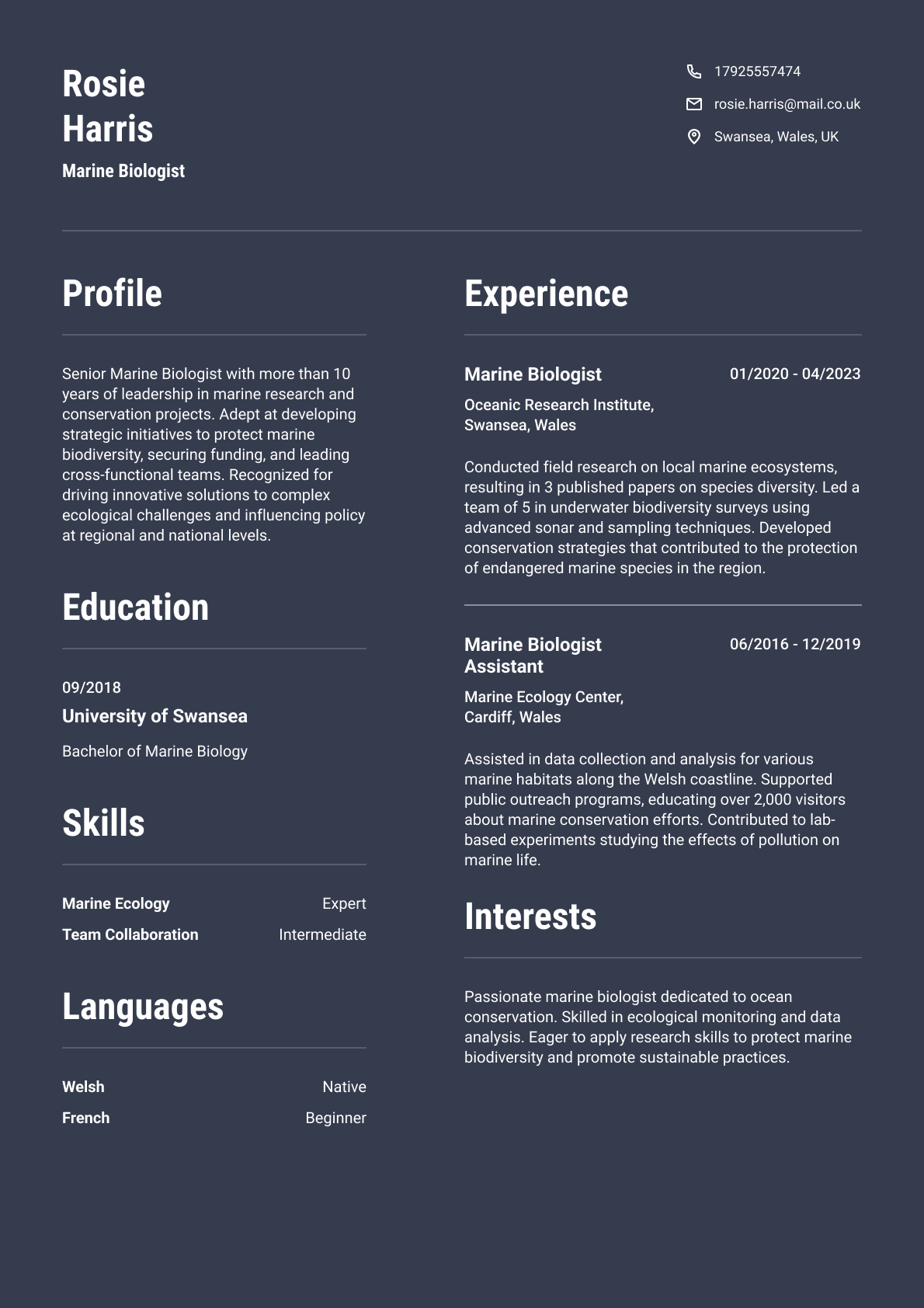
Every organization focused on marine ecosystems requires skilled marine biologists, and a standout marine biologist resume must demonstrate expertise across various essential aspects.
Marine biologists understand that meticulous research and data accuracy are crucial to scientific progress, and these principles apply equally to crafting a compelling resume. Your resume is the first impression you make on hiring committees, so it needs to reflect your professionalism and specialized knowledge effectively.
Resume guide for a marine biologist resume
Fitly here to assist. Our resume builder and verified resume examples for over 500 professions provide the edge needed to excel in your search for a marine biologist position. This guide and the accompanying marine biologist resume example cover these key topics:
- Selecting an effective resume format tailored to marine biology
- Presenting your contact information clearly
- Crafting a powerful summary statement
- Detailing your marine biology work experience
- Highlighting vital technical and soft skills
- Listing your academic background and certifications
- Choosing the best layout and design for your resume
Let's jump right in!
Resume example (text format)
Caoimhe Walsh
Marine Biologist
[email protected] 865551133 Bray, County Wicklow, IE
Profile
Experienced Marine Biologist with more than 10 years of expertise in marine research, ecosystem management, and conservation strategy development. Leader in designing and implementing large-scale marine projects that have influenced policy changes and sustainable practices. Skilled in managing multidisciplinary teams, securing research funding, and driving innovative initiatives to address critical ocean health issues. Recognized for strategic thinking and a passion for safeguarding marine environments at a global scale.
Work Experience
02/2020 - Present, Marine Biologist, Oceanic Research Institute, Bray, County Wicklow
- Conducted ecological assessments of local marine environments to monitor biodiversity and water quality.
- Led a team of researchers in studying the impact of climate change on coastal marine species.
- Developed and implemented conservation strategies that resulted in a 15% increase in native fish populations.
- Published peer-reviewed articles on marine habitat health and contributed to national environmental policies.
06/2015 - 01/2020, Research Associate, Coastal Marine Laboratory, Dublin, Ireland
- Collected and analyzed data on marine invertebrates and plant life along the Irish coast.
- Assisted in the design and execution of long-term ecological monitoring projects.
- Collaborated with local conservation groups to promote marine protection initiatives.
08/2012 - 05/2015, Marine Science Intern, Marine Environment Agency, Galway, Ireland
- Supported field surveys and sample collection for marine biodiversity assessments.
- Gained hands-on experience with marine sampling techniques and data recording.
- Prepared reports on findings and presented results at regional environmental conferences.
Education
09/2018, MSc Marine Biology, University College Dublin, Dublin, Ireland
06/2012, BSc Biology with Marine Ecology, Trinity College Dublin, Dublin, Ireland
03/2021, Certified Marine Biologist (CMIB), International Marine Science Association, Dublin, Ireland
Skills
- Marine Ecosystems Analysis
- Scientific Research & Data Collection
- Marine Conservation Strategies
- Critical Thinking & Problem Solving
- Communication & Report Writing
How to write a marine biologist resume
Before drafting, it's important to understand what key components your marine biologist resume needs. Include these critical sections:
- Profile
- Work Experience
- Education
- Skills
Your resume should showcase the specialized expertise you bring as a marine biologist. Begin by researching the organization and position you’re aiming for. Identify their marine research focus or conservation goals to tailor your resume to demonstrate why you are their ideal candidate. Follow this approach:
- Emphasize your scientific achievements, not just your routine responsibilities. Showcasing research findings and contributions proves your impact.
- Customize your resume for each job application to align writing style and keywords with the employer’s expectations.
- Maintain a polished, clear, and professional style that mirrors the analytical nature of marine biology.
- Incorporate relevant keywords and terminologies to ensure that both human readers and applicant tracking systems quickly understand your expertise.
Choosing the right resume format for marine biology
Your resume should be organized, professional, and easy to follow—qualities essential for a successful marine biologist.
The reverse chronological format is typically ideal, presenting your latest marine biology roles first and moving backward through your career history.
If you’re shifting from a related scientific field or have a diverse skill set, a functional resume focusing on your relevant skills might be advantageous. Alternatively, a hybrid format combining chronological and functional elements can effectively highlight your experience and competencies.
Explore our resume templates and select the one best aligned with your career stage and background. Numerous examples illustrate each format, offering guidance.
Ensure your marine biologist resume employs a crisp and professional layout that reinforces your scientific credibility.
Include your contact information
Your resume header should clearly identify you and make it effortless for employers to reach you, presented in a professional manner.
Essential details to include are:
- Your full name
- Your professional email address
- Your phone number
- Your LinkedIn or research profile (when applicable)
Avoid listing:
- Your full home address
- Unnecessary personal information
Make use of a summary
The marine biology profession is highly analytical yet innovative, and your resume summary is the perfect place to blend your scientific expertise with your passion for marine ecosystems. This brief section should reveal your professional identity and set you apart from typical candidates.
View your marine biologist resume summary as a concise narrative of your skills, professional approach, and research accomplishments. This section allows for more creative freedom compared to the rest of the resume’s bullet-point format.
Use strong action verbs and confident language to convey your competencies and enthusiasm clearly. Avoid repeating details listed elsewhere; instead, highlight themes that define your professional character and unique value.
Below are adaptable marine biologist resume summary samples:
Entry-level adaptable resume summary/profile example
Enthusiastic recent Marine Biology graduate with a strong foundation in marine ecosystems, biodiversity assessment, and research methodologies. Eager to apply academic knowledge in real-world environments while developing practical skills through hands-on internships. Demonstrates a passion for ocean conservation and a commitment to continuous learning. Highly motivated to contribute to impactful marine research projects.
Mid-level adaptable resume summary/profile example
Marine Biologist with over 4 years of experience conducting ecological surveys, species identification, and habitat assessments. Proven track record of contributing to conservation projects that improved marine biodiversity outcomes by 15%. Proficient in using GIS, scuba diving, and data analysis tools to support research objectives. Adept at collaborating with interdisciplinary teams and communicating scientific findings effectively.
Senior adaptable resume summary/profile example
Experienced Marine Biologist with more than 10 years of expertise in marine research, ecosystem management, and conservation strategy development. Leader in designing and implementing large-scale marine projects that have influenced policy changes and sustainable practices. Skilled in managing multidisciplinary teams, securing research funding, and driving innovative initiatives to address critical ocean health issues. Recognized for strategic thinking and a passion for safeguarding marine environments at a global scale.
Outline your marine biology work experience
Using a reverse chronological format, start with your most recent or current marine biology position and work backwards. Limit your history to the last 10-15 years to maintain relevance and avoid potential age bias.
Include only relevant roles directly connected to marine research, conservation, or associated fields. For unrelated positions, consider a separate 'Other Experience' section.
Under each employer and title, present your key contributions and achievements in clear, concise bullet points without personal pronouns. Begin each with a strong action verb such as conducted, analyzed, developed, or led.
Instead of listing routine duties, focus on measurable outcomes and scientific impact. Where possible, quantify your achievements with data and results to enrich your resume's effectiveness.
Consider these generic examples:
- Conducted marine ecosystem research
- Collected and analyzed oceanographic samples
- Prepared scientific reports and presentations
Now compare to more precise, impactful examples:
- Led a multi-year study on coral reef resilience improving understanding of bleaching events
- Analyzed water quality data for 20 coastal sites, influencing regional conservation strategies
- Published 5 peer-reviewed articles and presented findings at international marine science conferences
See the marine biologist work history example below:
Marine biologist employment history resume sample
02/2020 - Present, Marine Biologist, Oceanic Research Institute, Bray, County Wicklow
- Conducted ecological assessments of local marine environments to monitor biodiversity and water quality.
- Led a team of researchers in studying the impact of climate change on coastal marine species.
- Developed and implemented conservation strategies that resulted in a 15% increase in native fish populations.
- Published peer-reviewed articles on marine habitat health and contributed to national environmental policies.
06/2015 - 01/2020, Research Associate, Coastal Marine Laboratory, Dublin, Ireland
- Collected and analyzed data on marine invertebrates and plant life along the Irish coast.
- Assisted in the design and execution of long-term ecological monitoring projects.
- Collaborated with local conservation groups to promote marine protection initiatives.
08/2012 - 05/2015, Marine Science Intern, Marine Environment Agency, Galway, Ireland
- Supported field surveys and sample collection for marine biodiversity assessments.
- Gained hands-on experience with marine sampling techniques and data recording.
- Prepared reports on findings and presented results at regional environmental conferences.
Include the relevant key skills
Marine biology emphasizes technical proficiencies, so your resume will largely feature hard skills such as proficiency in marine data analysis tools, fieldwork techniques, and lab procedures. However, soft skills like collaboration, critical thinking, and adaptability are also essential.
Keep your resume focused and tailored to the specific marine biology role you are applying for to avoid overwhelming the reader. Maintain a master skill list and select the most relevant ones per application.
Fitly provides a variety of pre-written skills in our resume builder for convenience, and you may add other competencies as needed.
Below is an example layout of key skills for a marine biologist resume:
Marine biologist key skills resume sample
- Marine Ecosystems Analysis
- Scientific Research & Data Collection
- Marine Conservation Strategies
- Critical Thinking & Problem Solving
- Communication & Report Writing
Detail your education & certifications
The education section highlights the academic foundation crucial for a marine biologist. Since marine biology is a scientific discipline, hiring managers expect at least a bachelor’s degree in marine biology, biology, ecology, or a related field, with many candidates holding advanced degrees.
If you hold a bachelor's or higher degree, you can omit high school details. Include any relevant professional development, certifications, or specialized training such as:
- Graduate degrees in marine science or environmental science
- Certifications in scuba diving, GIS, laboratory techniques, or data analysis software
- Memberships in marine science societies or professional organizations
- Relevant internships or fieldwork programs, especially for early-career professionals
Marine biologist education & certifications resume sample
09/2018, MSc Marine Biology, University College Dublin, Dublin, Ireland
06/2012, BSc Biology with Marine Ecology, Trinity College Dublin, Dublin, Ireland
03/2021, Certified Marine Biologist (CMIB), International Marine Science Association, Dublin, Ireland
Pick the right resume layout and design
A well-structured and visually clear layout is essential for highlighting your qualifications and guiding the recruiter through your marine biologist resume effectively.
Aim for a clean, professional design that reflects your precise and methodical approach to research. Marine biologists are perceived as detail-conscious and analytical, so your formatting should reinforce those qualities.
Consider the message your chosen template sends about your candidacy. For most research roles, simplicity and clarity are paramount, but for outreach or educational positions, a slightly more creative style can be appropriate.
Explore our tested resume templates that handle design challenges so you can focus on content.
Marine biologist job market and outlook
The field of marine biology continues to grow with increasing emphasis on environmental conservation and marine resource management. Job opportunities are expanding due to global focus on climate change and ocean health.
Employment growth for marine biologists is projected to be steady over the next decade as research institutions, environmental organizations, and government agencies seek expertise.
Average salaries for marine biologists vary by experience and location but generally range from $50,000 to $80,000 annually, with senior researchers and specialized roles earning more.
Demand remains strong as ocean conservation initiatives and marine science programs increase worldwide.
Those with advanced degrees and strong technical skills often have the best prospects in this competitive field.
Key takeaways
Marine biology is a dynamic and growing science with increasing opportunities driven by environmental awareness and marine conservation efforts.
A well-crafted resume tailored to marine biology clearly showcases specialized skills, research achievements, and relevant education.
Customizing each application by highlighting measurable scientific contributions can distinguish your resume from others.
A clean, professional layout paired with concise content ensures your resume communicates competence and credibility effectively.
Investing time in a polished marine biologist resume enhances your chances of securing rewarding roles in this vital scientific field.
