
Every healthcare setting benefits from skilled occupational therapists, and any Occupational Therapist resume worthy of recruiters’ attention must stand out across several important factors.
Occupational Therapists understand that detailed patient care and purposeful intervention planning are essential, and the same precision applies when crafting your resume. Your resume is your initial introduction to potential employers, so it's crucial to make a strong, accurate impression.
Resume guide for an occupational therapist resume
Fitly here to guide you. Our resume builder and carefully curated resume examples for over 500 professions will equip you with a competitive edge in securing your ideal Occupational Therapist role. This resume guide and the accompanying occupational therapist resume example explore the following critical areas:
- Selecting the optimal resume format for occupational therapy
- Properly presenting your contact information
- Crafting a compelling summary
- Detailing your occupational therapy experience
- Highlighting relevant key skills
- Showcasing your education and certifications
- Choosing the most effective resume layout and design
Let's begin!
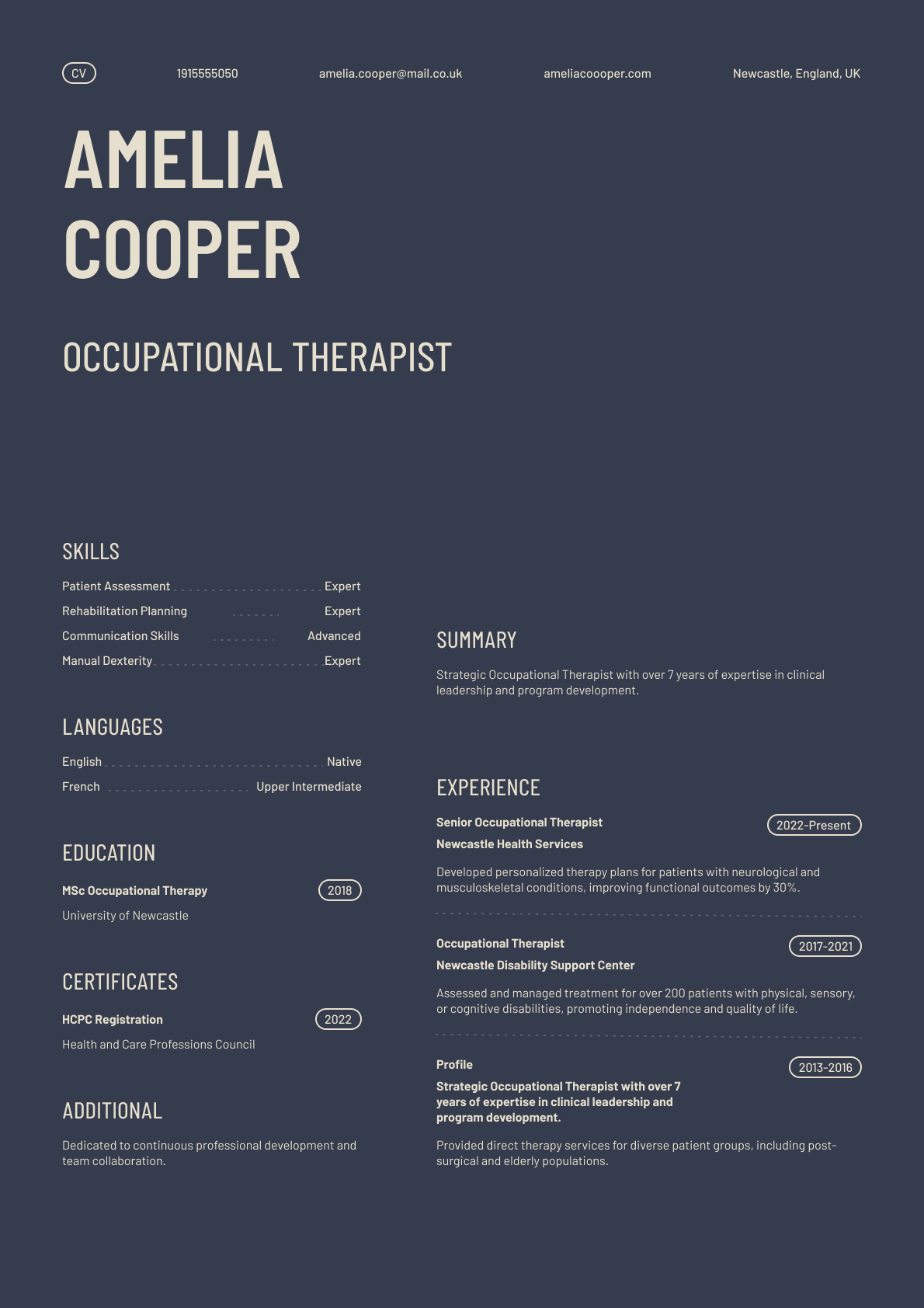
Resume example (text format)
Amelia Cooper
Occupational Therapist
amelia.cooper@mail.co.uk 1915555050 Newcastle, England, UK
Profile
Strategic Occupational Therapist with over 7 years of expertise in clinical leadership and program development. Adept at implementing innovative therapy models that enhance operational efficiency and patient satisfaction across healthcare facilities. Proven track record in mentoring staff, leading quality improvement initiatives, and influencing policy to advance occupational therapy practices.
Work Experience
01/2022 - Present, Senior Occupational Therapist, Newcastle Health Services, Newcastle, England
- Developed personalized therapy plans for patients with neurological and musculoskeletal conditions, improving functional outcomes by 30%.
- Led a team of 5 junior therapists, providing mentorship and training to enhance clinical skills and ensure compliance with healthcare standards.
- Collaborated with multidisciplinary teams to integrate patient care strategies, resulting in a 15% reduction in hospital readmission rates.
06/2017 - 12/2021, Occupational Therapist, Newcastle Disability Support Center, Newcastle, England
- Assessed and managed treatment for over 200 patients with physical, sensory, or cognitive disabilities, promoting independence and quality of life.
- Designed and facilitated occupational therapy workshops focused on daily living skills, attended by more than 100 participants annually.
- Implemented new therapeutic techniques that enhanced patient engagement and improved therapy effectiveness by 20%.
09/2013 - 05/2017, Junior Occupational Therapist, Northumbria Community Health, Newcastle, England
- Provided direct therapy services for diverse patient groups, including post-surgical and elderly populations.
- Conducted patient assessments and recommended modifications for home and workplace environments to enhance safety and accessibility.
- Participated in multidisciplinary case conferences to develop comprehensive care plans tailored to patient needs.
Education
09/2018, MSc in Occupational Therapy, University of Newcastle, Newcastle upon Tyne
06/2015, Bachelor's Degree in Human Biology, University of Newcastle, Newcastle upon Tyne
11/2022, Registered Occupational Therapist (HCPC), Health and Care Professions Council, UK
Skills
- Patient Assessment
- Rehabilitation Planning
- Excellent Communication Skills
- Manual Dexterity
- Empathy and Compassion
How to write an occupational therapist resume
Before you start, it’s essential to understand the key sections your occupational therapist resume should include. These are:
- Profile
- Work Experience
- Education
- Skills
Your resume should emphasize your unique contributions as an occupational therapist. Begin by gathering comprehensive information about the healthcare facility or organization you are applying to. Understand their patient population and rehabilitation goals to present yourself as the ideal candidate to meet their needs. To achieve this, adhere to the following guidelines:
- Emphasize your patient outcomes and therapy successes, not merely your responsibilities. Detailing your achievements highlights the impact you’ve had on clients' lives.
- Customize your resume for each application by mirroring the employer’s language and values in your wording and style.
- Project a polished, professional image with a resume template that is clear and approachable, avoiding overly formal or cluttered designs.
- Integrate pertinent keywords and industry terminology to ensure your qualifications are readily recognized by both human readers and automated systems.
Choosing the right resume format for occupational therapy
Your resume should be clear, professional, and easy to navigate—qualities that reflect excellent occupational therapy practice.
Among the common resume formats, the reverse chronological format is most effective. It highlights your most recent clinical experiences first, followed by earlier roles.
If you are transitioning to occupational therapy or have gaps in your history, a functional format focusing on skills and competencies instead of timelines can be advantageous. Hybrid resumes, combining chronological and functional elements, suit many therapists balancing diverse experiences.
Explore various layouts in our resume builder to select a format that matches your career stage and goals. Numerous template options are available, offering different resume design variations.
Opt for clean, modern, and professional designs in your occupational therapist resume to convey your strong clinical and interpersonal skills effectively.
Include your contact information
The resume header is your chance to clearly state your identity and contact methods, making it effortless for recruiters to reach you. Present this information in a professional, accessible way.
What should you include?
- Your full name
- Your professional email address
- Your phone number
- Your LinkedIn profile or professional portfolio (if relevant)
Avoid adding:
- Your home address
- Unnecessary personal details
Create a compelling summary
Occupational therapy is a people-centered profession, and your resume summary is an ideal place to convey your compassionate approach along with your clinical expertise. This section presents your professional story and personality to hiring managers.
Consider this summary as both your elevator pitch and a reflection of your unique therapeutic style. It offers a chance to distinguish yourself beyond bullet-point lists that dominate other resume sections.
Use dynamic language, action words, and positive descriptions to reflect your commitment and capabilities. Avoid regurgitating resume details; instead, present overarching themes about your therapeutic philosophy and key successes.
Below are adaptable occupational therapist resume summary examples you can tailor:
Entry-level adaptable resume summary/profile example
Motivated entry-level Occupational Therapist with a strong academic background in rehabilitation sciences and hands-on clinical training. Eager to apply foundational therapeutic techniques to improve patient independence and quality of life. Demonstrates excellent communication and empathetic skills, committed to continuing professional development and team collaboration.
Mid-level adaptable resume summary/profile example
Experienced Occupational Therapist with over 3 years of diverse clinical practice in outpatient and inpatient settings. Skilled in developing personalized therapy plans that have improved patient outcomes by up to 30%. Proficient in assessment tools, adaptive equipment, and multidisciplinary team coordination to deliver comprehensive care.
Senior adaptable resume summary/profile example
Strategic Occupational Therapist with over 7 years of expertise in clinical leadership and program development. Adept at implementing innovative therapy models that enhance operational efficiency and patient satisfaction across healthcare facilities. Proven track record in mentoring staff, leading quality improvement initiatives, and influencing policy to advance occupational therapy practices.
Outline your occupational therapy work experience
Following the reverse chronological format, list your most recent or current occupational therapy positions first, moving backward in time. Limit your listed experience to the past 10-15 years as older roles may be less relevant and can contribute to age bias.
Include only experience directly relevant to the occupational therapy role you seek. For other relevant but less central roles, consider adding an 'Additional Experience' section.
Under each employer and job title, present your clinical contributions and results in concise bullet points. Avoid personal pronouns such as 'I' or 'my.' Start with action verbs that illustrate your impact, such as conducted, facilitated, assessed, designed, or collaborated.
Focus on measurable patient outcomes and improvements rather than routine tasks. Specific accomplishments and quantifiable results greatly strengthen your resume.
Consider these generic bullet points:
- Performed therapeutic interventions
- Assessed patient progress
- Maintained therapy documentation
These statements lack detail and impact. Here is how you can enhance them:
- Implemented individualized therapy programs for a caseload of 25 patients, improving functional independence by 30% on average
- Collaborated with interdisciplinary teams to develop comprehensive rehabilitation plans, resulting in increased patient satisfaction scores
- Streamlined documentation processes, reducing administrative time by 15% and enhancing compliance with regulatory standards
See the occupational therapist employment history resume example below for guidance:
Occupational therapist employment history resume sample
01/2022 - Present, Senior Occupational Therapist, Newcastle Health Services, Newcastle, England
- Developed personalized therapy plans for patients with neurological and musculoskeletal conditions, improving functional outcomes by 30%.
- Led a team of 5 junior therapists, providing mentorship and training to enhance clinical skills and ensure compliance with healthcare standards.
- Collaborated with multidisciplinary teams to integrate patient care strategies, resulting in a 15% reduction in hospital readmission rates.
06/2017 - 12/2021, Occupational Therapist, Newcastle Disability Support Center, Newcastle, England
- Assessed and managed treatment for over 200 patients with physical, sensory, or cognitive disabilities, promoting independence and quality of life.
- Designed and facilitated occupational therapy workshops focused on daily living skills, attended by more than 100 participants annually.
- Implemented new therapeutic techniques that enhanced patient engagement and improved therapy effectiveness by 20%.
09/2013 - 05/2017, Junior Occupational Therapist, Northumbria Community Health, Newcastle, England
- Provided direct therapy services for diverse patient groups, including post-surgical and elderly populations.
- Conducted patient assessments and recommended modifications for home and workplace environments to enhance safety and accessibility.
- Participated in multidisciplinary case conferences to develop comprehensive care plans tailored to patient needs.
Highlight the relevant key skills
Occupational therapy demands a blend of hard and soft skills, with an emphasis on clinical knowledge and patient-centered abilities. Approximately 90% of your resume content may focus on measurable hard skills such as therapeutic techniques, adaptive equipment expertise, and knowledge of medical terminology.
Soft skills are equally vital, capturing how you engage with patients, families, and healthcare teams. Attributes like empathy, communication, patience, and problem-solving drive your effectiveness.
Your resume should be concise and targeted for the specific occupational therapy job you seek, so avoid listing every skill indiscriminately. Maintain a master list of your competencies and selectively include those most relevant to each application.
Our resume builder includes many pre-written key skills for occupational therapists, and you can add individualized skills as well.
Here's a snapshot of the skills section from an occupational therapist resume:
Occupational therapist key skills resume sample
- Patient Assessment
- Rehabilitation Planning
- Excellent Communication Skills
- Manual Dexterity
- Empathy and Compassion
Showcase your education & certifications
Your education section should highlight your academic background relevant to occupational therapy practice. Given that occupational therapy requires formal education, this section is essential for demonstrating your qualifications.
Most occupational therapists have a minimum of a bachelor's degree in occupational therapy or a related health field, often supplemented by a master's or doctoral degree.
List undergraduate and advanced degrees, omitting high school unless you are a recent graduate with limited higher education. Also include certifications and licenses relevant to occupational therapy, such as:
- Occupational Therapist Registered (OTR) credentials
- National Board for Certification in Occupational Therapy (NBCOT) certification
- State licensure information
- Specialty certifications such as Hand Therapy Certification or Sensory Integration courses
- Professional development workshops and memberships in occupational therapy associations
- Internships or clinical placements, especially for those newly entering the profession
Occupational therapist education & certifications resume sample
09/2018, MSc in Occupational Therapy, University of Newcastle, Newcastle upon Tyne
06/2015, Bachelor's Degree in Human Biology, University of Newcastle, Newcastle upon Tyne
11/2022, Registered Occupational Therapist (HCPC), Health and Care Professions Council, UK
Select the appropriate resume layout and design
Your choice of layout, design, and formatting sets the foundation for capturing recruiters’ attention toward your occupational therapist resume. These elements create the first impression hiring professionals will form.
To communicate professionalism, empathy, and expertise, select a clean, classic design style. Occupational therapists are viewed as compassionate, methodical, and highly skilled—reflect these qualities in your resume.
Before finalizing your template, consider what the format conveys about you as a professional. For most clinical roles, a simple yet elegant template works best, while certain employers might appreciate a slightly creative or modern edge.
To find inspiration, review our carefully tested resume templates where essential formatting and structure are thoughtfully prepared for you.
Occupational therapist job market and outlook
The demand for occupational therapists continues to grow steadily due to an aging population and increased focus on rehabilitative care. Employment for occupational therapists is projected to increase by 17% from 2021 to 2031, much faster than the average for all occupations, according to the Bureau of Labor Statistics.
This growth is driven by expanded healthcare services in hospitals, nursing facilities, and schools, as well as increasing awareness of occupational therapy's benefits.
The median annual salary for occupational therapists is approximately $86,000, with the top 10% of earners making over $120,000 per year.
Given the strong outlook and competitive compensation, occupational therapy remains a promising career choice for healthcare professionals committed to improving quality of life through therapeutic intervention.
Key takeaways
Occupational therapy is a profession experiencing robust growth, emphasizing patient-centered rehabilitation and holistic care. The projected job growth rate of 17% from 2021 to 2031 reflects rising demand.
Careful resume preparation tailored to occupational therapy roles increases your chances of standing out in a competitive market. Prioritize highlighting patient outcomes, clinical expertise, and relevant certifications.
Annual salaries are attractive, with median earnings around $86,000 and potential to earn significantly more with experience and advanced qualifications.
By presenting a clear, professional resume reflecting your unique skills and experience, you position yourself favorably for rewarding occupational therapist opportunities in a growing healthcare landscape.
Focused preparation and targeted job search strategies will help you succeed in this fulfilling field.
