
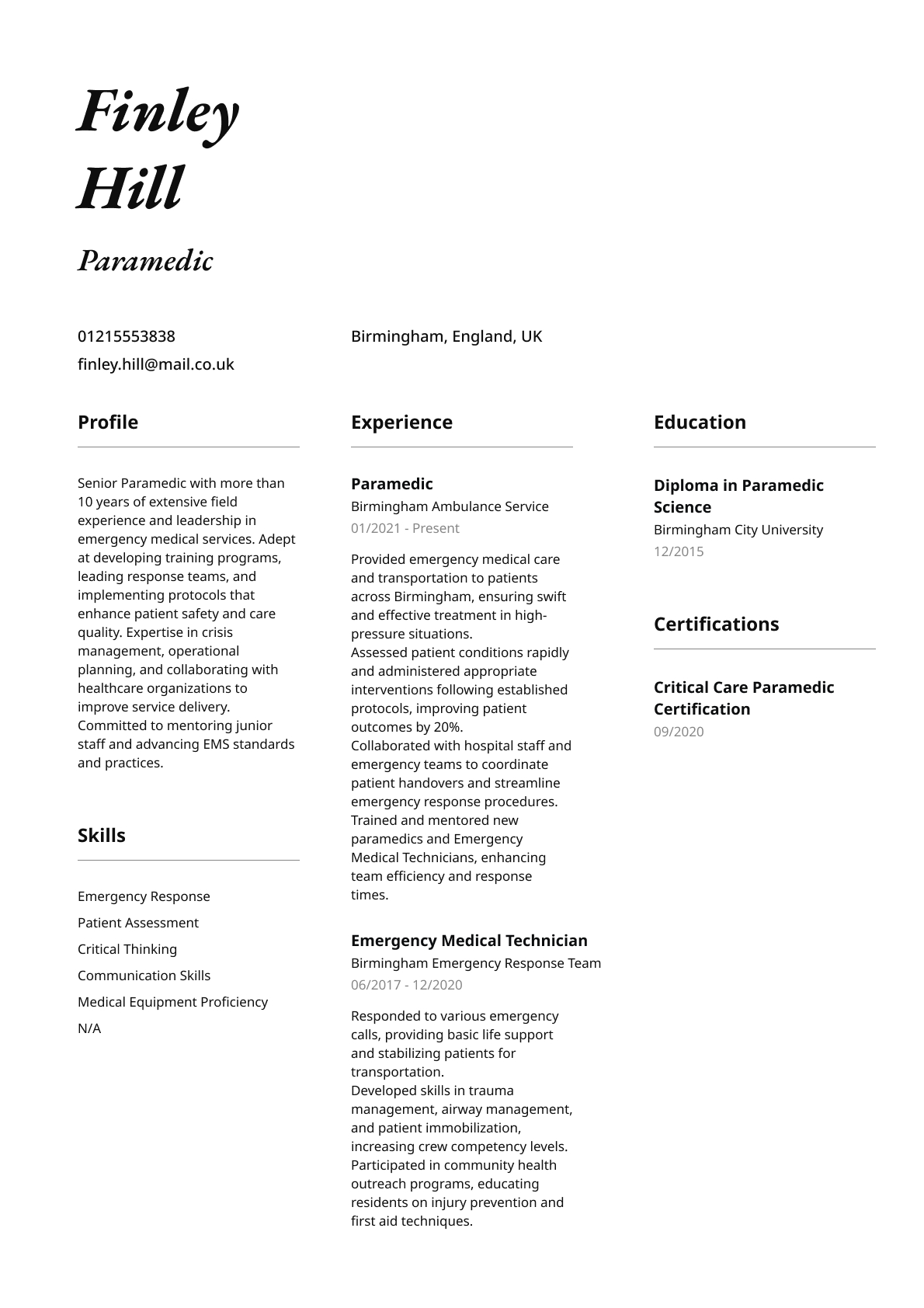
Every emergency situation demands a skilled paramedic, and every paramedic resume that aims to impress potential employers must highlight a combination of technical expertise and compassionate care.
Paramedics understand that quick thinking and precise action can save lives, and the same principles apply to crafting a compelling resume. Your resume creates the first impression for hiring managers, so it's essential to present your qualifications clearly and professionally.
Resume guide for a paramedic resume
Fitly here to help. Our resume builder and field-tested resume examples for over 500 professions will give you the advantage to stay ahead in your pursuit of a dream paramedic job. This resume guide and corresponding paramedic resume example will cover the following topics:
- Selecting the optimal resume format for paramedics
- Including your essential contact details
- Crafting an effective professional summary
- Detailing your paramedic work experience
- Highlighting relevant skills
- Documenting your education & certifications
- Choosing the appropriate resume layout and design
Let's dive in!
Resume example (text format)
Gabriel Lavoie
Paramedic
gabriel.lavoie@mail.ca 2505556677 Kelowna, British Columbia, CA
Profile
Seasoned paramedic with over 10 years of comprehensive experience in emergency medical services, including leadership roles overseeing EMS teams and operations. Expertise in strategic planning, crisis management, and implementing best practices for patient care and safety protocols. Demonstrated success in developing training programs, improving operational efficiencies, and leading large-scale emergency response initiatives. Committed to enhancing EMS standards and mentoring the next generation of emergency medical professionals.
Work Experience
05/2020 - Present, Paramedic, Okanagan Emergency Services, Kelowna, BC
- Respond to emergency calls, providing pre-hospital care for a wide range of medical situations, including trauma, cardiac emergencies, and respiratory issues.
- Operate and maintain advanced life support medical equipment, ensuring preparedness for various emergency scenarios.
- Collaborate with healthcare providers and police services to ensure timely and efficient patient transport and care.
- Conduct continuous training sessions for new team members, enhancing team response protocols and emergency care procedures.
02/2016 - 04/2020, Emergency Medical Technician (EMT), Kelowna Ambulance, Kelowna, BC
- Provided essential emergency medical care and patient transport services across Kelowna and surrounding areas.
- Assisted paramedics in advanced procedures and performed initial patient assessments.
- Maintained accurate documentation of patient care reports and medical interventions performed during emergencies.
Education
06/2015, Diploma in Paramedicine, Okanagan College, Kelowna, BC
09/2014, Emergency Medical Responders Certification, British Columbia Emergency Medical Services, Kelowna, BC
03/2018, Advanced Cardiac Life Support (ACLS) Certification, American Heart Association, Remote/Online
Skills
- Emergency Medical Services
- Patient Assessment and Care
- CPR and Advanced Life Support (ALS)
- Communication and Teamwork
- Critical Thinking and Decision Making
How to write a paramedic resume
Before you get started, you need to know what your paramedic resume should include. Here are the necessary sections:
- Profile
- Work Experience
- Education
- Skills
Your resume should reflect the unique qualities you bring as a paramedic. To start, gather as much information as possible about the emergency services provider and specific role you’re applying for. Understand the critical needs and emphasize how your skills and experiences align perfectly with saving lives and providing emergency medical care. To do this well, stick to this formula:
- Highlight your accomplishments, not just your responsibilities. Anyone can list duties, but showcasing outcomes such as successful emergency interventions demonstrates your true value.
- Customize your resume for each application by tailoring the tone and terminology to the employer’s preferences.
- Present a professional, concise image with a resume template that's clear and easy to read, reflecting your readiness under pressure.
- Use relevant keywords to help both automated systems and recruiters swiftly gauge your qualifications.
Choosing the right resume format for paramedics
Your resume should be clear, professional, and easy to follow—the same traits essential in the field as a paramedic.
The reverse chronological format is usually best, highlighting your most current experience first and moving backwards. This helps prospective employers see your latest and most relevant roles upfront.
If you're transitioning from a different healthcare role or have a diverse background, a functional format emphasizing skills and certifications could be advantageous. Alternatively, a hybrid format combines both chronological and functional aspects for a balanced presentation.
Explore resume templates in our builder and select one that fits your expertise and career stage. Opt for a clean, streamlined, and professional layout to reinforce your personal brand as a capable paramedic.
Include your contact information
The resume header should clearly identify you and provide straightforward ways for employers to reach you. Make this information prominent and professional.
Include the following:
- Your full name
- Your email address
- Your phone number
- Your LinkedIn profile or professional affiliations (if applicable)
Avoid including:
- Your full home address
- Unnecessary personal details
Utilize an impactful professional summary
Paramedicine is a high-pressure healthcare profession, but that shouldn't stop you from conveying your empathy, dedication, and professionalism in your resume summary. This section, also called a profile, humanizes your resume and helps break the stereotype of emergency workers being solely clinical.
Think of your paramedic resume summary as a compelling narrative of your skills, experience, and interpersonal qualities. Unlike the bullet-heavy sections, this part allows a more conversational tone, combining expertise with your personal approach to patient care.
Use dynamic language, strong action verbs, and positive framing. Avoid repeating information line-by-line from your resume; instead, highlight broad themes of your work style, achievements, and commitment to emergency medical services.
Below, you’ll find adaptable paramedic resume summary examples tailored to different experience levels:
Entry-level adaptable resume summary/profile example
Enthusiastic and dedicated paramedic with a strong foundation in emergency medical procedures and patient care. Recent graduate with hands-on clinical training and a passion for providing immediate, compassionate assistance in high-pressure situations. Eager to apply my knowledge and develop practical skills in a dynamic pre-hospital environment. Committed to ongoing learning and professional growth in emergency medical services.
Mid-level adaptable resume summary/profile example
Experienced paramedic with over 4 years of delivering high-quality emergency medical care in fast-paced environments. Proven ability to manage complex medical situations, administer advanced life support, and coordinate with medical teams to ensure patient safety. Skilled in equipment operation, patient assessment, and maintaining calm under pressure, consistently achieving positive patient outcomes. Adept at training new team members and contributing to protocols that improve response efficiency.
Senior adaptable resume summary/profile example
Seasoned paramedic with over 10 years of comprehensive experience in emergency medical services, including leadership roles overseeing EMS teams and operations. Expertise in strategic planning, crisis management, and implementing best practices for patient care and safety protocols. Demonstrated success in developing training programs, improving operational efficiencies, and leading large-scale emergency response initiatives. Committed to enhancing EMS standards and mentoring the next generation of emergency medical professionals.
Document your paramedic work history
Following a reverse chronological order, place your most recent or current paramedic position at the top, then work backwards. Limit your detailed experience to the last 10-15 years, focusing on roles most relevant to emergency medical services.
Only include positions related directly to paramedicine or emergency response. For unrelated jobs, consider an “Other Experience” section to maintain clarity and focus.
Under each job title and employer, use succinct bullet points to describe your key responsibilities and accomplishments. Avoid personal pronouns like “I” or “my.” Begin each bullet with a strong action verb to demonstrate impact—examples include administered, triaged, stabilized, coordinated, and expedited.
Rather than merely describing duties, emphasize measurable results. Including specific data enhances credibility and sets you apart from generic resumes.
For instance, generic points like these:
- Provided emergency medical care at accident scenes
- Assisted with patient transportation
- Maintained medical equipment and supplies
Are less compelling than:
- Administered critical life-saving interventions to over 200 patients annually, resulting in a 95% survival rate in high-risk emergencies
- Coordinated rapid patient transport with hospital teams, reducing response times by 15%
- Managed medical inventory and equipment upkeep to ensure 100% readiness of emergency vehicles
Review the paramedic employment history resume sample below for inspiration:
Paramedic employment history resume sample
05/2020 - Present, Paramedic, Okanagan Emergency Services, Kelowna, BC
- Respond to emergency calls, providing pre-hospital care for a wide range of medical situations, including trauma, cardiac emergencies, and respiratory issues.
- Operate and maintain advanced life support medical equipment, ensuring preparedness for various emergency scenarios.
- Collaborate with healthcare providers and police services to ensure timely and efficient patient transport and care.
- Conduct continuous training sessions for new team members, enhancing team response protocols and emergency care procedures.
02/2016 - 04/2020, Emergency Medical Technician (EMT), Kelowna Ambulance, Kelowna, BC
- Provided essential emergency medical care and patient transport services across Kelowna and surrounding areas.
- Assisted paramedics in advanced procedures and performed initial patient assessments.
- Maintained accurate documentation of patient care reports and medical interventions performed during emergencies.
Showcase key paramedic skills
Paramedicine requires a strong blend of hard and soft skills. Hard skills include proficiency in advanced life support, trauma management, and use of emergency medical equipment. Soft skills cover critical thinking, teamwork, effective communication, and emotional resilience under pressure.
Your resume should succinctly reflect the skills most relevant to the specific paramedic role you’re targeting. Maintain a master list of competencies you possess and tailor the skills section on each resume iteration to closely match the job description and requirements.
When using our resume builder, you'll find a selection of pre-written paramedic skills, but you can always add custom skills to best showcase your strengths.
Here’s an example of the skills section in our paramedic resume template:
Paramedic key skills resume sample
- Emergency Medical Services
- Patient Assessment and Care
- CPR and Advanced Life Support (ALS)
- Communication and Teamwork
- Critical Thinking and Decision Making
Highlight your education & certifications
The education section of your resume presents your formal medical training and certifications critical to paramedic roles. Employers expect training credentials, emergency medical technician (EMT) qualifications, and any advanced certifications.
Most paramedics hold a diploma or associate degree in emergency medical services or related health sciences, along with key certifications such as:
- National or State Paramedic Certification
- Advanced Cardiac Life Support (ACLS)
- Pediatric Advanced Life Support (PALS)
- Basic Life Support (BLS)
- CPR certification
- Continuing education courses and professional development seminars
If you have recent education or specialized training, be sure to highlight it prominently rather than listing outdated or unrelated studies.
Paramedic education & certifications resume sample
06/2015, Diploma in Paramedicine, Okanagan College, Kelowna, BC
09/2014, Emergency Medical Responders Certification, British Columbia Emergency Medical Services, Kelowna, BC
03/2018, Advanced Cardiac Life Support (ACLS) Certification, American Heart Association, Remote/Online
Select an effective resume layout and design
The right layout, design, and formatting create a polished first impression and help keep recruiters focused on the most important information in your paramedic resume.
A clean, straightforward, and organized layout aligns with the professionalism expected in emergency medical roles. It should avoid clutter and highlight your qualifications clearly and logically.
Consider what the design conveys about you as a candidate. For most paramedic positions, a traditional, easy-to-read format is ideal, but some employers may appreciate a more modern or dynamic design reflecting innovation and agility.
Browse our resume templates for options that combine practical formatting with a professional look suited to paramedics.
Paramedic job market and outlook
The demand for paramedics remains strong as emergency medical services are a crucial component of healthcare systems worldwide. Employment for paramedics is projected to grow steadily in the coming decade.
Growth is driven by an increasing population, rising healthcare needs, and expanded emergency response programs.
The median annual salary for paramedics varies by region but averages around $36,000 to $45,000, with experienced professionals and those working in urban areas often earning higher wages.
Job stability and advancement opportunities exist through gaining specialized certifications, supervisory roles, or transitioning into related healthcare fields.
Key takeaways
Paramedicine is a vital and in-demand healthcare profession with steady job prospects fueled by continuing public health needs and emergency response growth.
A well-crafted paramedic resume highlights your clinical expertise, quick decision-making, and compassionate patient care.
Emphasize measurable achievements, relevant certifications, and tailored skills aligned with the job description to stand out to employers.
Keep your resume clear, professional, and focused on the aspects that best demonstrate your readiness to respond effectively to emergencies and support patient outcomes.
Use available resume templates and field-tested examples to ensure your application is polished and impactful.
