
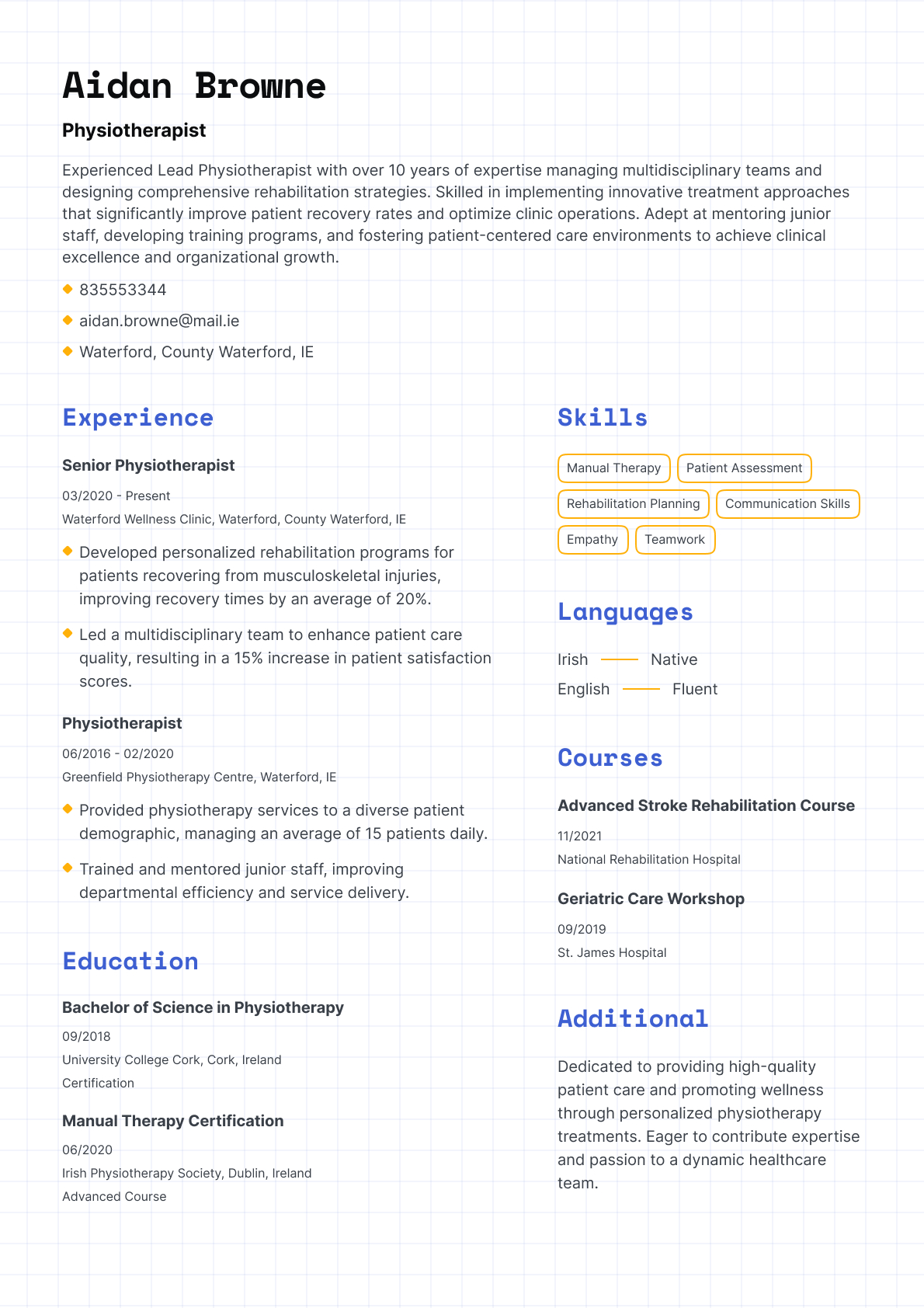
Every healthcare facility relies on skilled physiotherapists, and every physiotherapist resume deserving of an employer’s consideration must stand out through multiple key aspects.
Physiotherapists understand the importance of precise evaluation and patient-centered care, and these principles extend to crafting a compelling resume. Your resume forms the initial impression for hiring managers, so it's essential to make it impactful and professional.
Resume guide for a physiotherapist resume
At your service. Our resume builder and proven resume examples across various healthcare roles will equip you with the edge needed to secure your ideal physiotherapist position. This guide and the accompanying physiotherapist resume sample will walk you through:
- Selecting the optimal resume format for physiotherapy
- Providing clear contact information
- Leveraging an engaging professional summary
- Detailing your physiotherapy work experience effectively
- Highlighting essential physiotherapy skills
- Documenting your education & professional certifications
- Choosing a polished resume layout and design
Let's get started!
Resume example (text format)
Lucy Green
Physiotherapist
lucy.green@mail.co.uk 1582555667 Luton, England, UK
Profile
Experienced Physiotherapist with over 10 years of comprehensive healthcare experience, specializing in advanced rehabilitation techniques and complex case management. Proven leader in developing departmental protocols that improved treatment efficacy andpatient throughput by 20%. Adept at mentoring junior staff, leading multidisciplinary teams, and implementing new technologies and methodologies to enhance patient recovery programs. Strategic thinker focused on optimizing healthcare delivery, driving quality improvements, and contributing to policy development to advance physiotherapy practices.
Work Experience
03/2020 - 12/2022, Physiotherapist, Luton Healthcare Clinic, Luton, England
- Provided personalized physiotherapy treatments to patients recovering from musculoskeletal injuries, improving recovery rates by 25%.
- Developed tailored rehabilitation programs, resulting in increased patient satisfaction scores.
- Collaborated with multidisciplinary teams to ensure comprehensive patient care and progress tracking.
06/2015 - 02/2020, Junior Physiotherapist, Luton Physiotherapy Center, Luton, England
- Assisted senior physiotherapists in delivering treatment plans to a diverse patient demographic.
- Conducted initial patient assessments and documented progress, contributing to accurate treatment adjustments.
- Led patient education workshops on injury prevention and self-management techniques.
09/2012 - 05/2015, Physiotherapy Intern, University Hospital Luton, Luton, England
- Supported physiotherapy staff in patient care activities under supervision, gaining foundational clinical experience.
- Assisted in developing exercise programs, helping improve patient mobility outcomes.
- Participated in research projects focused on effective pain management strategies.
Education
09/2018, MSc in Physiotherapy, University of Bedfordshire, Luton, England
06/2014, Bachelor of Science in Physiotherapy, University of Birmingham, Birmingham, England
03/2021, Gait Analysis Certification, Chartered Society of Physiotherapy, London, England
Skills
- Manual Therapy
- Patient Assessment
- Exercise Prescription
- Excellent Communication Skills
- Rehabilitation Planning
How to write a physiotherapist resume
Before diving in, be clear about what your physiotherapist resume should encompass. Key sections typically include:
- Professional Profile
- Clinical Work Experience
- Education & Training
- Relevant Skills
Your resume should reflect your unique approach and expertise as a physiotherapist. Begin by researching the hiring organization and the specific role. Understand their patient care philosophy and tailor your resume to demonstrate how you meet their needs. Follow these guidelines:
- Focus on accomplishments and patient outcomes, not just clinical tasks performed. Demonstrating real impact highlights your effectiveness.
- Customize your resume for each job application, matching tone and keywords to each employer.
- Present a polished, professional image using a clean, well-structured template that is approachable yet authoritative.
- Integrate relevant clinical terminology and keywords to ensure your resume stands out in applicant tracking systems (ATS) and to human readers alike.
Choosing the right resume format for physiotherapy
Your resume should strike a balance between clarity, professionalism, and readability—qualities essential to a competent physiotherapist.
The recommended format is reverse chronological, showcasing your most recent clinical roles first, then earlier positions.
If you’re shifting specialties or entering physiotherapy from a different background, a functional format emphasizing your skills and competence may be beneficial. A combination (hybrid) format can also work well to balance experience and skills.
Explore various templates in our resume builder to find the best style that suits your career path. Many examples of each format are ready to inspire you.
Opt for a clean and contemporary layout that reflects the professionalism of your physiotherapist brand.
Include your contact information
Your resume header is your chance to clearly present who you are and how you can be reached. It should be professional and easy to access.
Include:
- Your full name
- Your professional email address
- Your phone number
- Your LinkedIn profile (if applicable)
Avoid including:
- Your home address
- Personal details irrelevant to the job
Leverage a compelling summary
Physiotherapy is a client-focused profession, and your resume summary is the perfect space to communicate your personalized care philosophy and professional strengths. This section allows you to bring warmth and professionalism together, breaking the stereotype of clinical detachment.
Think of your physiotherapist summary as a brief narrative that highlights your expertise, compassionate approach, and key achievements. This is where creativity is acceptable, unlike the typically standardized bullet-point sections.
Use active verbs, confident phrasing, and an engaging tone to establish your distinct professional identity. Avoid redundancy; instead, convey your value and work style succinctly.
Below you’ll find versatile physiotherapist resume summary examples designed to adapt to your experience level:
Entry-level adaptable resume summary/profile example
Recent physiotherapy graduate with a strong foundation in human anatomy and rehabilitation techniques. Eager to apply practical skills and learn from experienced clinicians to deliver effective patient care. Demonstrates excellent communication and a compassionate approach to supporting patient recovery. Enthusiastic about developing expertise in physiotherapy modalities and patient management. Seeking an opportunity to contribute to a dynamic healthcare team and grow professionally.
Mid-level adaptable resume summary/profile example
Physiotherapist with over 3 years of clinical experience in outpatient and inpatient settings, successfully managing a diverse caseload of patients with musculoskeletal, neurological, and post-surgical conditions. Skilled in developing personalized treatment plans that improve patient outcomes, evidenced by a 30% increase in patient satisfaction scores. Proficient in manual therapy, electrotherapy, and rehabilitation exercises, with a proven ability to work collaboratively with multidisciplinary teams. Committed to ongoing professional development and delivering evidence-based care.
Senior adaptable resume summary/profile example
Experienced Physiotherapist with over 10 years of comprehensive healthcare experience, specializing in advanced rehabilitation techniques and complex case management. Proven leader in developing departmental protocols that improved treatment efficacy andpatient throughput by 20%. Adept at mentoring junior staff, leading multidisciplinary teams, and implementing new technologies and methodologies to enhance patient recovery programs. Strategic thinker focused on optimizing healthcare delivery, driving quality improvements, and contributing to policy development to advance physiotherapy practices.
Detail your physiotherapy work experience
In line with the reverse chronological format, list your most recent or current physiotherapy roles at the top and work backward. Limit entries to the past 10-15 years to ensure relevance and prevent age bias.
Include only positions relevant to physiotherapy. For unrelated jobs, consider a separate "Other Experience" section.
Under each employer entry, use concise bullet points to highlight your contributions and patient outcomes. Avoid personal pronouns; begin each bullet with a strong action verb such as treated, rehabilitated, designed, assessed, or facilitated.
Go beyond listing duties by showcasing measurable results and clinical improvements. Specific metrics add credibility and distinguish your resume.
For instance, vague bullets like:
- Provided physical therapy treatments
- Assisted patients with rehabilitation exercises
- Documented patient progress
can be greatly improved with details like:
- Treated an average of 20 patients daily, achieving a 90% satisfaction rate through personalized rehabilitation plans
- Designed targeted exercise programs leading to a 30% faster recovery time for post-operative patients
- Maintained detailed patient progress records ensuring compliance with regulatory standards
View the physiotherapist employment history example below for further inspiration:
Physiotherapist employment history resume sample
03/2020 - 12/2022, Physiotherapist, Luton Healthcare Clinic, Luton, England
- Provided personalized physiotherapy treatments to patients recovering from musculoskeletal injuries, improving recovery rates by 25%.
- Developed tailored rehabilitation programs, resulting in increased patient satisfaction scores.
- Collaborated with multidisciplinary teams to ensure comprehensive patient care and progress tracking.
06/2015 - 02/2020, Junior Physiotherapist, Luton Physiotherapy Center, Luton, England
- Assisted senior physiotherapists in delivering treatment plans to a diverse patient demographic.
- Conducted initial patient assessments and documented progress, contributing to accurate treatment adjustments.
- Led patient education workshops on injury prevention and self-management techniques.
09/2012 - 05/2015, Physiotherapy Intern, University Hospital Luton, Luton, England
- Supported physiotherapy staff in patient care activities under supervision, gaining foundational clinical experience.
- Assisted in developing exercise programs, helping improve patient mobility outcomes.
- Participated in research projects focused on effective pain management strategies.
Highlight critical physiotherapy skills
Physiotherapy relies heavily on both technical expertise and interpersonal skills. A robust physiotherapist resume balances hard skills, such as knowledge of therapeutic modalities and anatomy, with soft skills like empathy, communication, and problem-solving.
Your resume should be succinct and tailored for the specific role you’re targeting. To achieve this, maintain a master list of your skills and curate the most relevant for each application after reviewing the job description.
Our resume builder includes a variety of pre-written physiotherapy skills for your convenience, and you can also add customized skills as needed.
Here’s how a skills section might appear in a physiotherapist resume template:
Physiotherapist key skills resume sample
- Manual Therapy
- Patient Assessment
- Exercise Prescription
- Excellent Communication Skills
- Rehabilitation Planning
List your education & professional certifications
The education section on your resume should highlight the academic and clinical training that qualifies you as a physiotherapist. Since physiotherapy requires specialized education, this section is essential.
Most physiotherapists hold a degree in physiotherapy, kinesiology, or related health sciences. Advanced degrees or postgraduate certifications further enhance your qualifications.
Include relevant certifications such as:
- Licensed Physiotherapist accreditation or registration with a recognized physiotherapy board
- Specialty certifications like orthopedic or neurological physiotherapy
- CPR and First Aid certification
- Continued professional development courses and memberships in professional physiotherapy organizations
- Internships or clinical placements, especially if you are early in your career
Physiotherapist education & certifications resume sample
09/2018, MSc in Physiotherapy, University of Bedfordshire, Luton, England
06/2014, Bachelor of Science in Physiotherapy, University of Birmingham, Birmingham, England
03/2021, Gait Analysis Certification, Chartered Society of Physiotherapy, London, England
Select the ideal resume layout and design
A well-organized layout, coherent design, and clean formatting form the foundation for capturing recruiters’ attention on your physiotherapist resume.
To reflect the compassionate yet professional nature of physiotherapy, aim for a clean and approachable design. Your resume should communicate your dedication, expertise, and reliability.
Consider the message different resume templates convey. For many clinical roles, a straightforward and elegant format works best, while some innovative workplaces may appreciate a modern touch.
Explore our curated resume templates, designed to simplify formatting and highlight your qualifications effectively.
Physiotherapist job market and outlook
The demand for physiotherapists remains strong as healthcare advances and populations age. According to the U.S. Bureau of Labor Statistics, employment of physiotherapists is projected to grow approximately 19% from 2021 to 2031, considerably faster than the average for all occupations.
This growth is fueled by increased patient needs for rehabilitation from injuries and chronic illnesses as well as preventative care services.
The median annual wage for physiotherapists is around $95,000, with opportunities for higher earnings in specialized or private practice roles.
The positive job outlook makes physiotherapy a promising and stable career choice for healthcare professionals committed to patient well-being and recovery.
Key takeaways
Physiotherapy is a thriving profession with increasing demand as healthcare systems expand and populations age globally.
A well-crafted physiotherapist resume that highlights your clinical expertise, compassionate approach, and professional achievements greatly improves your hiring chances.
Utilize targeted keywords and quantifiable outcomes to bolster your resume’s impact and pass applicant tracking systems.
Choose a clean, professional resume format that aligns with your career goals and the employer’s expectations.
With careful preparation and customization, your physiotherapist resume can open doors to rewarding clinical opportunities and professional growth.
