
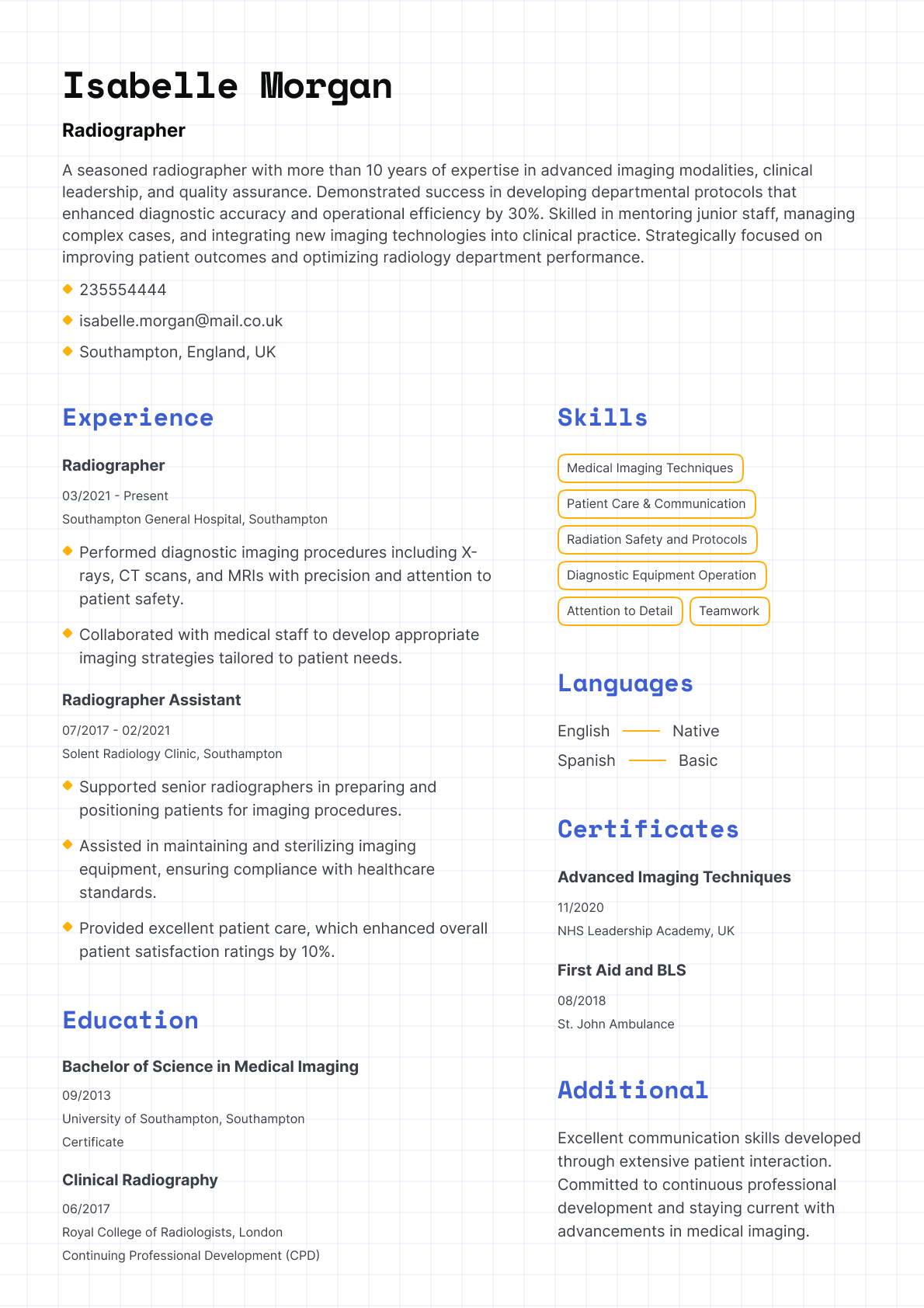
Every healthcare facility needs a radiographer, and every radiographer resume that earns the attention of prospective employers must meet several critical criteria.
Radiographers understand the importance of precision and safety when conducting imaging procedures, and these principles also apply when crafting your resume. Your resume creates a vital first impression for hiring managers, so it is essential to make it informative and professional.
Resume guide for a radiographer resume
Fitly here to help. Our resume builder and specialized resume examples for over 500 professions will provide you the edge you need to secure your ideal radiographer position. This guide and the accompanying radiographer resume sample will explore important topics such as:
- Selecting the optimal resume format for radiography roles
- Including clear and complete contact details
- Crafting an effective professional summary
- Detailing your radiography work experience
- Highlighting your key technical and interpersonal skills
- Presenting relevant educational background and certifications
- Choosing the best resume layout and visual design
Let's get started!
Resume example (text format)
Poppy Bell
Radiographer
poppy.bell@mail.co.uk 1902555223 Wolverhampton, England, UK
Profile
Experienced radiographer with over 10 years of expertise in advanced imaging techniques and departmental leadership. Skilled in developing and implementing imaging protocols, ensuring compliance with safety standards, and mentoring junior staff. Played a key role in the rollout of a new MRI suite that increased departmental capacity by 30% and reduced patient wait times. Strategic thinker committed to leveraging technology and process improvement to enhance diagnostic accuracy and operational efficiency.
Work Experience
03/2020 - Present, Radiographer, Wolverhampton Hospital, Wolverhampton, England
- Performed a wide range of diagnostic imaging procedures including X-rays, MRI, and CT scans with high precision and patient care focus.
- Collaborated with medical staff to ensure optimal imaging techniques, leading to a 15% increase in diagnostic accuracy.
- Maintained and calibrated imaging equipment, reducing downtime by 20% and ensuring compliance with safety standards.
- Guided and supported patients through procedures, enhancing patient comfort and reducing appointment time delays.
07/2016 - 02/2020, Radiography Technician, Midlands Imaging Centre, Birmingham, UK
- Assisted senior radiologists in performing advanced imaging procedures, ensuring adherence to safety and quality standards.
- Managed patient records and imaging data, improving workflow efficiency by implementing a new digital filing system.
- Participated in training workshops to stay updated on the latest imaging technologies and safety protocols.
09/2012 - 06/2016, Radiography Assistant, Stoke Medical Imaging, Stoke-on-Trent, UK
- Supported radiographers in preparing and positioning patients for imaging procedures, increasing setup efficiency.
- Assisted in maintaining and sterilizing imaging equipment, ensuring compliance with hospital safety regulations.
- Provided exceptional patient support, improving overall patient experience during imaging sessions.
Education
06/2014, Diploma of Diagnostic Radiography, University of Wolverhampton, Wolverhampton, England
09/2018, Postgraduate Certification in Advanced Imaging Techniques, University of Wolverhampton, Wolverhampton, England
11/2021, Certified Radiology Administrator (CRA), British Institute of Radiology, London, England
Skills
- Medical Imaging Techniques
- Patient Care and Communication
- Radiation Safety and Protection
- Equipment Maintenance and Troubleshooting
- Attention to Detail
How to write a radiographer resume
Before starting, understand the key sections your radiographer resume must include. Typically, these are:
- Professional Profile
- Work Experience
- Education
- Skills
Your resume should showcase the unique expertise you bring as a radiographer. Begin by researching the healthcare facility and position to comprehend their specific needs, and tailor your resume to demonstrate how you are the ideal candidate to fulfill them. Follow these best practices:
- Emphasize your achievements and contributions rather than simply listing job responsibilities. Highlight measurable outcomes where possible.
- Customize your resume for each job application, aligning the tone and style with the employer’s expectations.
- Maintain a polished and professional appearance with a clean and well-structured resume template.
- Use relevant keywords to ensure your resume passes applicant tracking systems and resonates with human reviewers.
Choosing the right resume format for radiography
Your radiographer resume should be clear, professional, and straightforward—the same attributes essential to the medical imaging profession.
The reverse chronological format is recommended as it highlights your most recent and relevant experience first, flowing back through your career history.
If you are changing careers or have an unconventional background, a functional format emphasizing skills over chronological work history may be beneficial. Alternatively, a hybrid format combining both elements can also be effective.
Explore various resume templates in our resume builder to find the layout that best suits your individual circumstances. Several examples of each format style are available for inspiration as well.
Use a professional, modern layout to reflect your reliability and expertise as a radiographer.
Include your contact information
Your resume header should clearly present your identity and how potential employers can reach you. It’s essential that this information is transparent and easy to find while appearing professional.
Be sure to include:
- Your full name
- Email address
- Phone number
- LinkedIn profile or professional portfolio (if available)
Avoid including:
- Home address
- Personal information unrelated to the job
Make use of a summary
Although radiography is a highly technical field, your radiographer resume should present a personable and service-oriented professional image. The summary (sometimes referred to as a profile) is a perfect place to illustrate both your clinical expertise and your interpersonal skills.
Think of your radiographer summary as a compelling narrative that highlights your qualifications and qualities. It’s one of the few sections where you can be creative while maintaining professionalism, as most other sections utilize standard bullet points.
Use dynamic language, action verbs, and a positive tone to stand out. Avoid merely restating your resume details; instead, provide overarching insights into your work style, accomplishments, and professional values.
Below are adaptable radiographer resume summary examples you can customize:
Entry-level adaptable resume summary/profile example
Enthusiastic and detail-oriented radiographer with a recent BS in Radiologic Technology and a strong foundation in imaging procedures. Eager to apply clinical knowledge and technical skills in a healthcare setting while continuing to learn advanced imaging techniques. Proven ability to work well under supervision and collaborate effectively with medical teams. Committed to providing high-quality patient care and ensuring safety in all imaging processes.
Mid-level adaptable resume summary/profile example
Skilled radiographer with over 4 years of experience in hospital and outpatient imaging environments. Proficient in a wide range of imaging modalities including X-ray, CT, and MRI, consistently delivering high-quality images that support accurate diagnoses. Successfully managed patient schedules, adhered to safety protocols, and reduced procedure times by 15% through process improvements. Adept at collaborating with healthcare professionals to optimize imaging workflows and improve patient outcomes.
Senior adaptable resume summary/profile example
Experienced radiographer with over 10 years of expertise in advanced imaging techniques and departmental leadership. Skilled in developing and implementing imaging protocols, ensuring compliance with safety standards, and mentoring junior staff. Played a key role in the rollout of a new MRI suite that increased departmental capacity by 30% and reduced patient wait times. Strategic thinker committed to leveraging technology and process improvement to enhance diagnostic accuracy and operational efficiency.
Outline your radiography work experience
Following a reverse chronological order, begin with your current or most recent radiographer position and work backward. Limit your work history to the past 10-15 years as earlier roles may be less relevant and could inadvertently invite bias.
Include only experiences pertinent to the radiographer role you are pursuing. If relevant, add a separate "Other Experience" section for unrelated jobs.
Under each employer and job title, use concise bullet points to describe your responsibilities and accomplishments. Refrain from personal pronouns and start each bullet with an impactful action verb such as operated, calibrated, assisted, optimized, or ensured.
Don’t merely list duties. Quantify your impact whenever possible to demonstrate measurable results. Without specificity, your resume might appear generic and uninspired.
For example, generic statements might be:
- Conducted imaging procedures
- Maintained radiology equipment
- Assisted patients during imaging
These lack detail and measurable outcomes. Improved versions could be:
- Performed over 500 high-quality diagnostic imaging procedures using X-ray and CT technology with zero safety incidents
- Maintained and calibrated imaging equipment, reducing downtime by 30% through proactive maintenance scheduling
- Provided compassionate patient care and education during imaging procedures, improving patient satisfaction scores by 15%
See the radiographer employment history resume example below for inspiration:
Radiographer employment history resume sample
03/2020 - Present, Radiographer, Wolverhampton Hospital, Wolverhampton, England
- Performed a wide range of diagnostic imaging procedures including X-rays, MRI, and CT scans with high precision and patient care focus.
- Collaborated with medical staff to ensure optimal imaging techniques, leading to a 15% increase in diagnostic accuracy.
- Maintained and calibrated imaging equipment, reducing downtime by 20% and ensuring compliance with safety standards.
- Guided and supported patients through procedures, enhancing patient comfort and reducing appointment time delays.
07/2016 - 02/2020, Radiography Technician, Midlands Imaging Centre, Birmingham, UK
- Assisted senior radiologists in performing advanced imaging procedures, ensuring adherence to safety and quality standards.
- Managed patient records and imaging data, improving workflow efficiency by implementing a new digital filing system.
- Participated in training workshops to stay updated on the latest imaging technologies and safety protocols.
09/2012 - 06/2016, Radiography Assistant, Stoke Medical Imaging, Stoke-on-Trent, UK
- Supported radiographers in preparing and positioning patients for imaging procedures, increasing setup efficiency.
- Assisted in maintaining and sterilizing imaging equipment, ensuring compliance with hospital safety regulations.
- Provided exceptional patient support, improving overall patient experience during imaging sessions.
Include the relevant key skills
Radiography roles require a combination of technical expertise and interpersonal abilities. Most of your resume should emphasize hard skills—such as proficiency with imaging modalities, radiation safety protocols, and equipment operation—but don’t neglect soft skills like communication, empathy, and teamwork.
Tailor the skills you highlight to match the specific job description. Maintain a master list of your competencies for easy reference, and selectively include the most pertinent skills for each application.
Our resume builder includes pre-written skill sets suitable for radiographers, but feel free to add specialized skills unique to your background.
The skills section in the radiographer resume template typically looks like this:
Radiographer key skills resume sample
- Medical Imaging Techniques
- Patient Care and Communication
- Radiation Safety and Protection
- Equipment Maintenance and Troubleshooting
- Attention to Detail
Detail your education & certifications
The education section of your radiographer resume is crucial to demonstrate your formal qualifications and professional development. Radiography is a field that requires specific academic credentials and certifications.
Typically, radiographers hold an associate or bachelor's degree in radiologic technology or medical imaging. Advanced certifications and continuing education enhance your professional profile.
Include any of the following relevant items:
- Academic degrees in radiologic technology, diagnostic imaging, or equivalent
- Certifications such as ARRT (American Registry of Radiologic Technologists), CPR certification, or state licensure
- Specialized training in modalities like MRI, CT, or ultrasound
- Professional development courses and memberships in radiography associations
- Clinical internships or practicums, especially for recent graduates
Radiographer education & certifications resume sample
06/2014, Diploma of Diagnostic Radiography, University of Wolverhampton, Wolverhampton, England
09/2018, Postgraduate Certification in Advanced Imaging Techniques, University of Wolverhampton, Wolverhampton, England
11/2021, Certified Radiology Administrator (CRA), British Institute of Radiology, London, England
Pick the right resume layout and design
The structure, design, and formatting of your resume are key to capturing and maintaining the recruiter’s attention on your radiographer qualifications.
A clean, classic design is optimal to reflect professionalism, attention to detail, and trustworthiness—qualities that are essential for radiographers.
Consider what message your chosen format conveys about your candidacy. For most clinical radiography positions, simplicity and clarity should be prioritized, though some employers may appreciate a modern or innovative touch.
Browse our tested resume templates, where formatting complexity has been thoughtfully managed for you.
Radiographer job market and outlook
The demand for radiographers remains strong and is projected to grow over the next decade. According to the U.S. Bureau of Labor Statistics, employment of radiologic technologists and technicians is expected to increase by approximately 7% from 2021 to 2031, faster than the average for all occupations.
This growth is driven by the aging population, increased use of diagnostic imaging in medical care, and technological advances in imaging techniques.
Radiographers earn a median annual wage of around $62,000, with top professionals earning upwards of $90,000 depending on specialization and location.
The outlook for radiographers is positive as healthcare facilities continue to rely on skilled imaging professionals for accurate diagnoses.
Key takeaways
The radiography profession is in demand with promising job growth predicted over the next decade. Skilled radiographers are essential to healthcare as imaging technologies continue to evolve.
Successful resumes highlight both technical qualifications and interpersonal skills, tailored to each position.
Craft your resume clearly and professionally to reflect your expertise and dedication as a medical imaging professional.
Stay current with certifications and training to remain competitive in this dynamic field.
With a well-prepared resume emphasizing your unique strengths, you can confidently pursue your career goals in radiography.
