
Every healthcare facility needs skilled respiratory therapists, and a respiratory therapist resume that stands out must meet several key criteria to impress potential employers.
Respiratory therapists understand the critical nature of respiratory care and patient well-being, and this same careful attention must be reflected in a thoughtfully crafted resume. Your resume creates a vital first impression with hiring managers, so it’s essential to present it professionally and effectively.
Resume guide for a respiratory therapist resume
Fitly here to help. Our resume builder and field-tested resume examples for over 500 professions will give you the advantage to stay ahead in your pursuit of a dream respiratory therapist job. This resume guide and corresponding respiratory therapist resume example will cover the following topics:
- Choosing the right resume format for respiratory therapy
- Include your contact information
- Make use of a summary
- Outline your respiratory therapist work experience
- Include the relevant key skills
- Detail your education & certifications
- Pick the right resume layout and design
Let's dive in!
Resume example (text format)
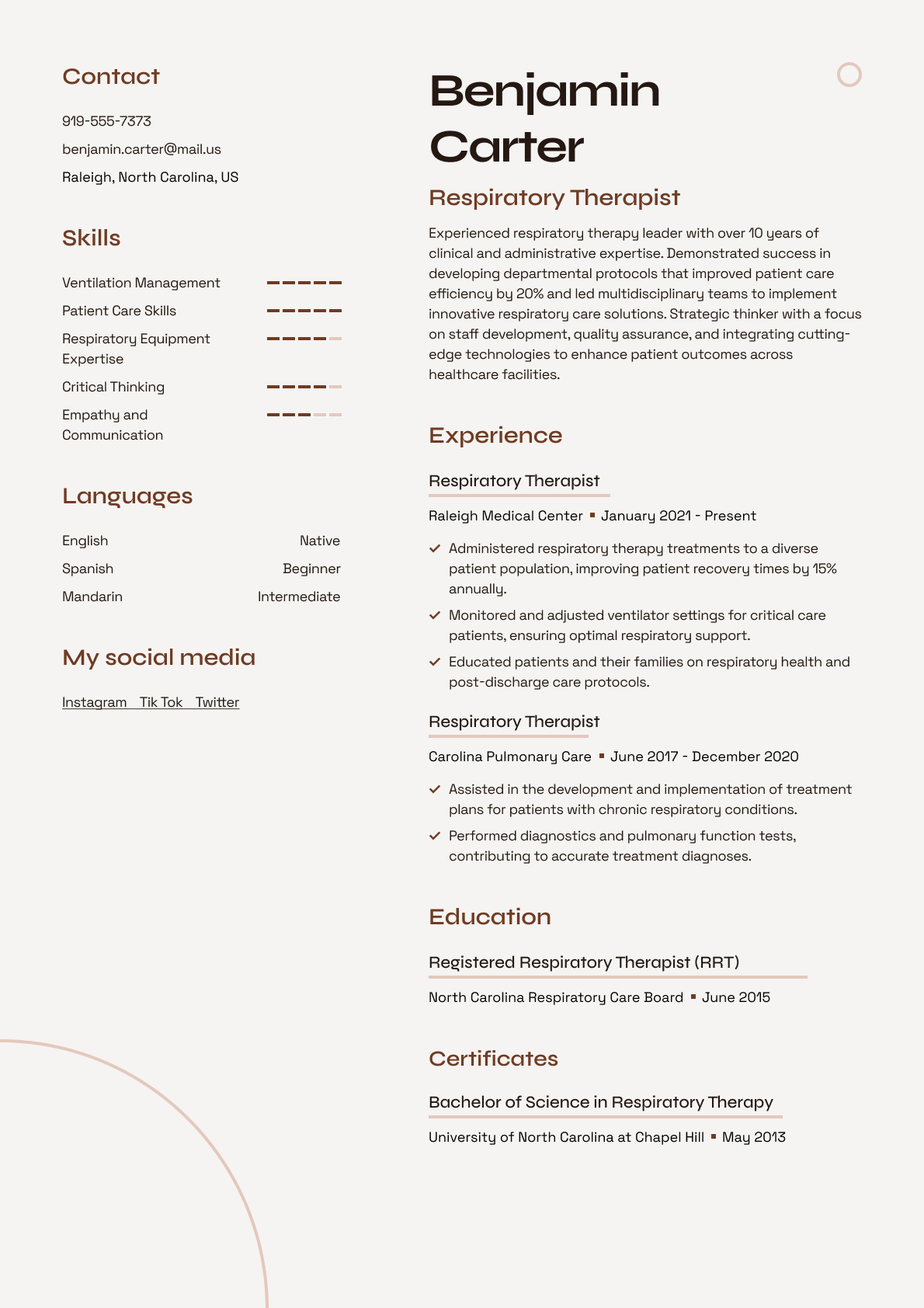
Benjamin Carter
Respiratory Therapist
benjamin.carter@mail.us 9195557373 Raleigh, North Carolina, US
Profile
Experienced respiratory therapy leader with over 10 years of clinical and administrative expertise. Demonstrated success in developing departmental protocols that improved patient care efficiency by 20% and led multidisciplinary teams to implement innovative respiratory care solutions. Strategic thinker with a focus on staff development, quality assurance, and integrating cutting-edge technologies to enhance patient outcomes across healthcare facilities.
Work Experience
01/2021 - Present, Respiratory Therapist, Raleigh Medical Center, Raleigh, NC
- Administered respiratory therapy treatments to a diverse patient population, improving patient recovery times by 15% annually.
- Monitored and adjusted ventilator settings for critical care patients, ensuring optimal respiratory support.
- Educated patients and their families on respiratory health and post-discharge care protocols.
06/2017 - 12/2020, Respiratory Therapist, Carolina Pulmonary Care, Raleigh, NC
- Assisted in the development and implementation of treatment plans for patients with chronic respiratory conditions.
- Performed diagnostics and pulmonary function tests, contributing to accurate treatment diagnoses.
- Trained new staff and interns on respiratory equipment and patient care procedures.
08/2014 - 05/2017, Respiratory Therapy Intern, WakeMed Health and Hospitals, Raleigh, NC
- Gained hands-on experience in administering aerosol therapies and managing mechanical ventilation.
- Assisted licensed respiratory therapists in patient assessments and treatment procedures.
Education
06/2015, Registered Respiratory Therapist (RRT), North Carolina Respiratory Care Board, Raleigh, NC
05/2013, Bachelor of Science in Respiratory Therapy, University of North Carolina at Chapel Hill, Chapel Hill, NC
09/2020, Certified Pulmonary Function Technician (CPFT), National Board for Respiratory Care, Raleigh, NC
Skills
- Ventilation Management
- Patient Care Skills
- Respiratory Equipment Expertise
- Critical Thinking
- Empathy and Communication
How to write a respiratory therapist resume
Before you get started, you need to know what your respiratory therapist resume should include. Here are the necessary sections:
- Profile
- Work Experience
- Education
- Skills
Your resume should reflect the unique expertise you bring as a respiratory therapist. To start, gather as much information as possible about the healthcare facility and the specific respiratory therapy role to which you're applying. Try to understand the organization's needs and prepare to demonstrate how you are the ideal respiratory therapist to address their patient care requirements. To do this effectively, consider the following approach:
- Emphasize your accomplishments, not just your responsibilities. Anyone can list tasks, but highlighting your measurable outcomes will prove your professional value.
- Customize your resume for each job application by tailoring language and format to align with the employer’s expectations.
- Present a polished, professional image with a clear and organized resume template—avoid clutter or overly complex formatting.
- Incorporate relevant industry keywords to ensure your resume resonates with applicant tracking systems and human readers alike.
Choosing the right resume format for respiratory therapy
Your resume should be clear, professional, and easy to navigate — qualities essential for an effective respiratory therapist.
Among various formats, the reverse chronological layout is typically the best choice. It highlights your most recent experience first, then traces back through earlier roles.
If you’re transitioning careers or have a diverse background, a functional format focusing on skills over job history might be helpful. Alternatively, a hybrid resume can blend chronological and functional elements to best showcase your qualifications.
Explore the templates in our resume builder to find the one that fits your unique situation. Numerous examples are also available for you to review.
Be sure to select a clean, modern, and professional design to reflect your capabilities as a respiratory therapist.
Include your contact information
The resume header is crucial to immediately identify you and provide easy ways for employers to reach you. Keep it professional and accessible.
Typical information to include:
- Your full name
- Your professional email address
- Your phone number
- Your LinkedIn profile or professional website (if applicable)
Avoid including:
- Your home address
- Personal details irrelevant to the job
Use a compelling summary
Respiratory therapy is a specialized medical field, yet your resume summary is an excellent place to showcase your dedication, empathy, and clinical expertise. This section offers an opportunity to differentiate yourself beyond technical skills.
Think of your respiratory therapist resume summary as a concise narrative of your professional strengths and character. Unlike other resume sections that follow a bullet-point format, your summary can use natural language to add vibrancy and personality.
Use strong action verbs, highlight key accomplishments, and express your passion for patient care. Avoid simply rephrasing your resume’s bullet points—instead, craft a story about your clinical approach and professional values.
Below are adaptable respiratory therapist resume summary examples for different experience levels:
Entry-level adaptable resume summary/profile example
Dedicated respiratory therapist with a recent certification and a strong foundation in patient care principles. Eager to apply academic knowledge gained through clinical rotations, demonstrating enthusiasm and a commitment to improving patient outcomes. Possesses excellent communication skills and a collaborative approach, ready to learn and grow within a healthcare team.
Mid-level adaptable resume summary/profile example
Certified respiratory therapist with over 3 years of experience delivering high-quality respiratory care in hospital settings. Successfully managed diverse patient needs, leading to a 15% improvement in recovery times and enhanced patient comfort. Proficient in ventilator management, ABG analysis, and advanced airway techniques, with a proven ability to work effectively under pressure and contribute to interdisciplinary teams.
Senior adaptable resume summary/profile example
Experienced respiratory therapy leader with over 10 years of clinical and administrative expertise. Demonstrated success in developing departmental protocols that improved patient care efficiency by 20% and led multidisciplinary teams to implement innovative respiratory care solutions. Strategic thinker with a focus on staff development, quality assurance, and integrating cutting-edge technologies to enhance patient outcomes across healthcare facilities.
Outline your respiratory therapist work experience
Following a reverse chronological format, list your current or most recent respiratory therapist position first, then work back through your prior roles. Limit your history to the past 10-15 years to keep details relevant and concise.
Include only experience directly related to respiratory therapy. For additional unrelated work, consider a separate "Other Experience" section.
Under each employer and job title, describe your responsibilities and achievements in clear, impactful bullet points—omit personal pronouns. Begin each point with a strong action verb such as monitored, assisted, administered, evaluated, or collaborated.
Focus on outcomes rather than duties. Whenever possible, include quantifiable metrics to demonstrate the scope and success of your work.
Generic bullet points might read:
- Performed respiratory assessments and treatments
- Administered oxygen therapy as prescribed
- Maintained patient records and equipment
These lack detail. Improved versions might say:
- Conducted respiratory assessments for 20+ patients daily in a high-acuity intensive care unit
- Administered tailored oxygen therapy protocols, improving patient oxygen saturation levels by 15%
- Maintained and calibrated respiratory equipment, ensuring 100% compliance with safety standards
Review the respiratory therapist employment history resume sample below for further guidance:
Respiratory Therapist employment history resume sample
01/2021 - Present, Respiratory Therapist, Raleigh Medical Center, Raleigh, NC
- Administered respiratory therapy treatments to a diverse patient population, improving patient recovery times by 15% annually.
- Monitored and adjusted ventilator settings for critical care patients, ensuring optimal respiratory support.
- Educated patients and their families on respiratory health and post-discharge care protocols.
06/2017 - 12/2020, Respiratory Therapist, Carolina Pulmonary Care, Raleigh, NC
- Assisted in the development and implementation of treatment plans for patients with chronic respiratory conditions.
- Performed diagnostics and pulmonary function tests, contributing to accurate treatment diagnoses.
- Trained new staff and interns on respiratory equipment and patient care procedures.
08/2014 - 05/2017, Respiratory Therapy Intern, WakeMed Health and Hospitals, Raleigh, NC
- Gained hands-on experience in administering aerosol therapies and managing mechanical ventilation.
- Assisted licensed respiratory therapists in patient assessments and treatment procedures.
Highlight relevant key skills
Respiratory therapy demands a blend of technical and interpersonal skills. Most of your resume will emphasize hard skills such as proficiency with respiratory care equipment, knowledge of pulmonary function tests, and understanding of respiratory pathology. However, soft skills like empathy, communication, and teamwork are equally important in patient-centered care.
Your resume should be concise and targeted to the respiratory therapist role. Keep a master list of your skills, then choose those that best match the job description for each application.
Fitly offers numerous pre-written key skills in the resume builder, and you can always add your own to customize your resume further.
Here’s what the skills section looks like in our respiratory therapist resume template:
Respiratory Therapist key skills resume sample
- Ventilation Management
- Patient Care Skills
- Respiratory Equipment Expertise
- Critical Thinking
- Empathy and Communication
Detail your education & certifications
The education section of your resume should showcase your academic qualifications supporting your career as a respiratory therapist. Since this is a specialized healthcare profession, hiring managers expect relevant degrees and certifications.
Most respiratory therapists hold an associate’s or bachelor’s degree in respiratory therapy or a related field, and many pursue advanced certifications.
Include pertinent certifications such as:
- Certified Respiratory Therapist (CRT)
- Registered Respiratory Therapist (RRT)
- Neonatal/Pediatric Specialist credentials
- Advanced Cardiovascular Life Support (ACLS) and Basic Life Support (BLS) certifications
- Continuing education and professional memberships relevant to respiratory care
Also mention internships or clinical rotations, especially if you are early in your career.
Respiratory Therapist education & certifications resume sample
06/2015, Registered Respiratory Therapist (RRT), North Carolina Respiratory Care Board, Raleigh, NC
05/2013, Bachelor of Science in Respiratory Therapy, University of North Carolina at Chapel Hill, Chapel Hill, NC
09/2020, Certified Pulmonary Function Technician (CPFT), National Board for Respiratory Care, Raleigh, NC
Choose the ideal resume layout and design
Effective layout, design, and formatting are key to grabbing the attention of recruiters reviewing your respiratory therapist resume. Together, they establish the first impression and professional tone.
A clean, straightforward design is your best choice, reflecting the precision and reliability valued in respiratory care professionals. A classical style communicates discipline and clinical expertise.
Consider the impression your chosen resume format creates. For most healthcare roles, simplicity and clarity work best, though some employers might appreciate a modern or creative touch depending on their culture.
For inspiration, browse our tested resume templates that take care of formatting and structure, so you can focus on your content.
Respiratory Therapist job market and outlook
Respiratory therapy remains a vital and expanding field within healthcare. According to the U.S. Bureau of Labor Statistics, employment for respiratory therapists is projected to grow by 23% from 2021 to 2031, much faster than the average for all occupations.
The aging population and increased prevalence of respiratory conditions contribute to this strong demand.
The median annual salary for respiratory therapists is approximately $62,000, with the top earners making over $90,000 per year.
The respiratory therapist job market is expected to stay robust as healthcare needs continue to grow and as awareness of respiratory health rises.
The need for skilled respiratory therapists will remain critical in hospitals, clinics, home care, and outpatient settings.
Key takeaways
Respiratory therapy is a rapidly growing healthcare profession with excellent job prospects. The demand for respiratory therapists is driven by demographic changes and increasing respiratory health awareness.
Preparing a targeted, well-organized resume that highlights both technical competence and compassionate patient care will increase your chances of landing your ideal respiratory therapist position.
The median salary for respiratory therapists hovers around $62,000 annually, with strong potential for growth based on experience and specialization.
Staying current with certifications and clinical skills is essential for success and career advancement in this dynamic field.
Use expert resume templates and proven strategies to craft a compelling respiratory therapist resume that opens doors to your next opportunity.
