
Every healthcare facility needs a skilled Speech-Language Pathologist, and every Speech-Language Pathologist resume that captures a hiring manager's attention must excel on multiple fronts.
Speech-Language Pathologists understand the importance of precise evaluation and individualized treatment planning in their work, and the same precision applies to crafting your resume. Your resume is your first chance to communicate your expertise to a potential employer, so ensuring it is polished and targeted is essential.
Resume guide for a Speech-Language Pathologist
We are here to assist you. Our resume builder and thoroughly vetted resume examples across hundreds of professions will equip you to stand out in your journey to secure a rewarding Speech-Language Pathologist position. This resume guide and the attached Speech-Language Pathologist resume example will discuss the following key points:
- Selecting the most suitable resume format for Speech-Language Pathology
- Providing your contact details clearly
- Utilizing a compelling summary section
- Presenting your Speech-Language Pathology work experience
- Listing relevant clinical and technical skills
- Detailing your education and professional certifications
- Choosing an appropriate resume layout and design
Let's get started!
Resume example (text format)
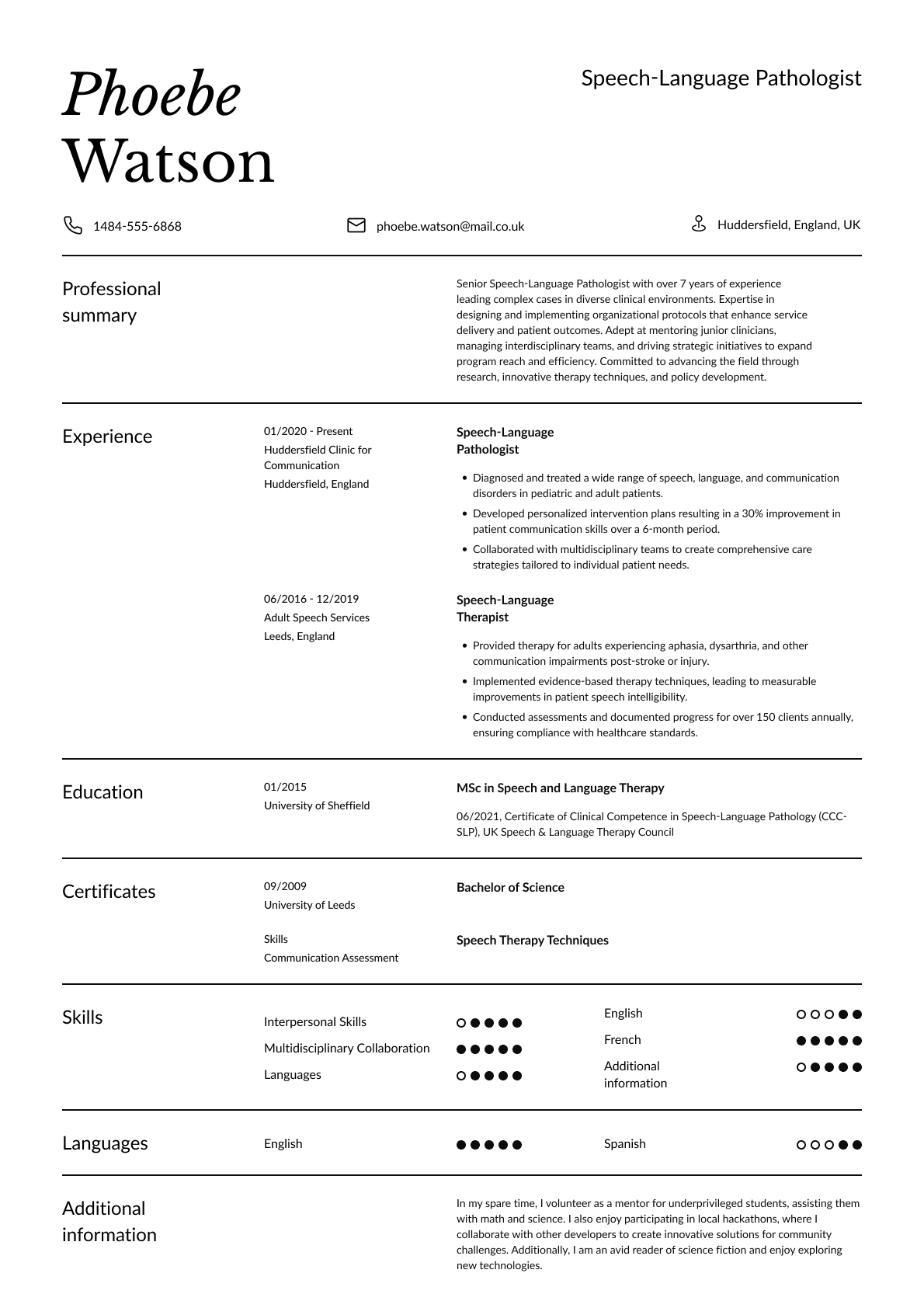
Phoebe Watson
Speech-Language Pathologist
phoebe.watson@mail.co.uk 14845556868 Huddersfield, England, UK
Profile
Senior Speech-Language Pathologist with over 7 years of experience leading complex cases in diverse clinical environments. Expertise in designing and implementing organizational protocols that enhance service delivery and patient outcomes. Adept at mentoring junior clinicians, managing interdisciplinary teams, and driving strategic initiatives to expand program reach and efficiency. Committed to advancing the field through research, innovative therapy techniques, and policy development.
Work Experience
01/2020 - Present, Speech-Language Pathologist, Huddersfield Clinic for Communication, Huddersfield, England
- Diagnosed and treated a wide range of speech, language, and communication disorders in pediatric and adult patients.
- Developed personalized intervention plans resulting in a 30% improvement in patient communication skills over a 6-month period.
- Collaborated with multidisciplinary teams to create comprehensive care strategies tailored to individual patient needs.
06/2016 - 12/2019, Speech-Language Therapist, Adult Speech Services, Leeds, England
- Provided therapy for adults experiencing aphasia, dysarthria, and other communication impairments post-stroke or injury.
- Implemented evidence-based therapy techniques, leading to measurable improvements in patient speech intelligibility.
- Conducted assessments and documented progress for over 150 clients annually, ensuring compliance with healthcare standards.
- Organized training workshops for caregivers and family members to support ongoing communication strategies at home.
Education
01/2015, MSc in Speech and Language Therapy, University of Sheffield, Sheffield, England
09/2009, Bachelor of Science in Communication Disorders, University of Leeds, Leeds, England
06/2021, Certificate of Clinical Competence in Speech-Language Pathology (CCC-SLP), UK Speech & Language Therapy Council
Skills
- Communication Assessment
- Speech Therapy Techniques
- Patient-Centered Care
- Interpersonal Skills
- Multidisciplinary Collaboration
How to write a Speech-Language Pathologist resume
Before you begin, it is important to understand the essential components of your Speech-Language Pathologist resume. Ensure it includes the following sections:
- Professional Profile
- Clinical Experience
- Education
- Key Skills
Your resume should communicate the unique professional qualities you bring as a Speech-Language Pathologist. Start by researching the organization and position you are applying for, understand their client needs, and tailor your resume to demonstrate how you can enhance their therapeutic services. Use the following strategy to achieve this:
- Emphasize your clinical achievements rather than simply listing your responsibilities. Concrete outcomes showcase your value more effectively.
- Customize your resume for each application by aligning tone and focus with the prospective employer's expectations.
- Maintain a professional, clear, and approachable style with a well-designed resume template.
- Include keywords pertinent to Speech-Language Pathology so both human readers and applicant tracking systems recognize your qualifications.
Choosing the right resume format for Speech-Language Pathology
Your resume should be clear, professional, and easy to navigate—the hallmark traits of an excellent Speech-Language Pathologist.
The reverse chronological format remains the top choice, highlighting your most recent clinical roles first and then moving backward through your career history.
If you are transitioning into Speech-Language Pathology or have a unique professional journey, a functional format emphasizing skills and competencies may be beneficial. Alternatively, a hybrid (combination) format can blend chronological and skills-based elements effectively.
Browse the diverse templates available in our resume builder to select the format that aligns with your career story. Many examples are available to illustrate each format.
Choose a clean, modern, or professional layout to reflect your clinical expertise and professional demeanor in your Speech-Language Pathologist resume.
Include your contact information
The resume header should unmistakably identify you and provide easy-to-locate contact details. Present this section in a professional and accessible manner.
Include the following:
- Your full name
- Email address
- Phone number
- LinkedIn profile or professional portfolio (if relevant)
Avoid including:
- Home address
- Personal details unrelated to the role
Crafting an effective summary
Speech-Language Pathology blends science and empathy, and your resume summary is the ideal space to convey both your professional expertise and interpersonal strengths. This section goes beyond technical qualifications by showcasing your approach to client care and therapy.
Think of your summary as a concise narrative that integrates your clinical skills with your passion for improving communication and quality of life for clients.
Use vibrant language, strong action verbs, and positive phrasing to express your unique value. Avoid merely rephrasing your resume; instead, highlight your key attributes, work style, and most significant accomplishments.
Below, you will find adaptable Speech-Language Pathologist resume summary examples for different career stages:
Entry-level adaptable resume summary/profile example
Motivated recent Speech-Language Pathology graduate with a solid academic foundation and hands-on clinical training. Eager to apply therapeutic techniques to help clients improve communication skills and overcome speech and language challenges. Demonstrates strong interpersonal skills and a commitment to continuous learning within a clinical setting. Enthusiastic about developing effective, personalized treatment plans for diverse patient populations.
Mid-level adaptable resume summary/profile example
Experienced Speech-Language Pathologist with over 3 years of clinical practice in pediatric and adult settings. Proven ability to improve patient communication outcomes through tailored therapy programs, increasing client retention and satisfaction. Proficient in the use of modern assessment tools and therapy software, with a track record of collaborating effectively with multidisciplinary teams to achieve treatment goals.
Senior adaptable resume summary/profile example
Senior Speech-Language Pathologist with over 7 years of experience leading complex cases in diverse clinical environments. Expertise in designing and implementing organizational protocols that enhance service delivery and patient outcomes. Adept at mentoring junior clinicians, managing interdisciplinary teams, and driving strategic initiatives to expand program reach and efficiency. Committed to advancing the field through research, innovative therapy techniques, and policy development.
Present your Speech-Language Pathology work experience
Following the reverse chronological approach, start this section with your current or latest clinical position and work backward. Limit your detailed work experience to the last 10-15 years, focusing on relevant positions to avoid overwhelming the reader with outdated information.
If you have other unrelated experience, consider including it separately under an “Additional Experience” heading.
For each role, list concise, results-focused bullet points that highlight your contributions. Begin bullets with dynamic action verbs such as evaluated, treated, collaborated, implemented, and documented, avoiding personal pronouns.
Move beyond listing duties by quantifying your impact whenever possible, such as client progress, caseload sizes, or program improvements. This specificity breaks stereotypes and demonstrates your clinical effectiveness.
Consider these generic examples:
- Provided speech therapy services
- Assessed communication disorders
- Maintained clinical records
These are vague and lack impact. Here’s how to enhance them with details:
- Conducted individualized speech therapy sessions for an average caseload of 25 pediatric clients weekly, improving articulation and fluency
- Performed comprehensive assessments leading to targeted intervention plans for clients with diverse communication challenges
- Streamlined documentation procedures, reducing administrative time by 20% and enhancing compliance with regulatory standards
Refer to the Speech-Language Pathologist employment history resume example below for guidance:
Speech-Language Pathologist employment history resume sample
01/2020 - Present, Speech-Language Pathologist, Huddersfield Clinic for Communication, Huddersfield, England
- Diagnosed and treated a wide range of speech, language, and communication disorders in pediatric and adult patients.
- Developed personalized intervention plans resulting in a 30% improvement in patient communication skills over a 6-month period.
- Collaborated with multidisciplinary teams to create comprehensive care strategies tailored to individual patient needs.
06/2016 - 12/2019, Speech-Language Therapist, Adult Speech Services, Leeds, England
- Provided therapy for adults experiencing aphasia, dysarthria, and other communication impairments post-stroke or injury.
- Implemented evidence-based therapy techniques, leading to measurable improvements in patient speech intelligibility.
- Conducted assessments and documented progress for over 150 clients annually, ensuring compliance with healthcare standards.
- Organized training workshops for caregivers and family members to support ongoing communication strategies at home.
Highlight the relevant key skills
Speech-Language Pathologists must balance technical expertise with interpersonal abilities. Hard skills, such as proficiency in diagnostic tools, therapy techniques, and familiarity with assistive technologies, form the bulk of your resume content. Soft skills like empathy, communication, patience, and critical thinking complement your clinical knowledge.
Keep your skills section concise and precisely tailored to the position. Maintaining a master list of your competencies can help you customize each application strategically based on the job requirements.
Our resume builder provides a variety of pre-written relevant skills to include, with flexibility to add any specialized areas you excel in.
Below is what a skills section might resemble in a Speech-Language Pathologist resume:
Speech-Language Pathologist key skills resume sample
- Communication Assessment
- Speech Therapy Techniques
- Patient-Centered Care
- Interpersonal Skills
- Multidisciplinary Collaboration
Detail your education & certifications
Your education section is critical to demonstrating your foundational knowledge and qualifications as a Speech-Language Pathologist. This field demands formal education and certification, so presenting this information clearly is vital.
Most Speech-Language Pathologists hold at least a master’s degree in Speech-Language Pathology or a related discipline.
Include relevant certifications such as:
- Certificate of Clinical Competence in Speech-Language Pathology (CCC-SLP) from the American Speech-Language-Hearing Association (ASHA)
- State licensure for Speech-Language Pathologists
- Specialized training in areas like pediatric speech therapy, aphasia rehabilitation, or augmentative and alternative communication (AAC)
- Professional development courses and memberships in associations such as ASHA or local speech pathology organizations
- Internship or clinical fellowship experiences, especially for those newly entering the profession
Speech-Language Pathologist education & certifications resume sample
01/2015, MSc in Speech and Language Therapy, University of Sheffield, Sheffield, England
09/2009, Bachelor of Science in Communication Disorders, University of Leeds, Leeds, England
06/2021, Certificate of Clinical Competence in Speech-Language Pathology (CCC-SLP), UK Speech & Language Therapy Council
Select the best resume layout and design
The structure, design, and formatting of your resume set the stage to engage the recruiter effectively. They create a powerful first impression that reflects your professionalism as a Speech-Language Pathologist.
A clean, classic design often best represents characteristics associated with clinicians: reliability, compassion, and expertise. Visual clarity helps communicate your skills and experience efficiently.
Consider what your chosen resume template says about you. For most clinical roles, a simple and elegant design is ideal, though certain employers might appreciate a more modern approach depending on the work environment.
Explore our curated resume templates, where we’ve simplified formatting and layout so you can focus on demonstrating your professional strengths.
Speech-Language Pathologist job market and outlook
Speech-Language Pathology is a growing healthcare profession with sustained demand. According to the U.S. Bureau of Labor Statistics, employment of Speech-Language Pathologists is projected to grow 21% from 2021 to 2031, much faster than the average for all occupations.
The increase in demand is fueled by greater awareness of communication disorders, an aging population requiring therapy, and expanded services for children with developmental challenges.
The average annual salary for Speech-Language Pathologists is approximately $80,000, though this varies by region, experience, and workplace setting.
Opportunities abound in hospitals, schools, rehabilitation centers, and private practices, making it a promising career path for passionate clinicians.
Consistent growth and rewarding work make Speech-Language Pathology an appealing profession for many healthcare professionals.
Key takeaways
The demand for Speech-Language Pathologists is rapidly increasing, driven by healthcare needs and growing awareness of communication disorders. This career offers strong job growth and diverse employment settings.
Successful resumes highlight demonstrated clinical impact, relevant certifications, and a balance of technical and interpersonal skills.
A carefully tailored, well-organized resume emphasizing your achievements and clinical expertise will set you apart.
Clean and professional presentation is essential to convey reliability and compassion, qualities central to excellence in Speech-Language Pathology.
With these strategies and tools, you can confidently pursue the rewarding role of a Speech-Language Pathologist and make a positive difference in the lives of your clients.
