
Every company that values user experience needs a skilled UX/UI Designer, and every UX/UI Designer resume worthy of an employer's consideration must meet several critical criteria.
UX/UI Designers understand that creativity, user empathy, and attention to detail are crucial in crafting engaging digital experiences, and these qualities must also shine through in their resumes. Your resume acts as your first portfolio piece to hiring teams, so it's vital to make it compelling and relevant.
Resume guide for a UX/UI Designer resume
Fitly here to help. Our resume builder and tested resume examples across 500+ professions will empower you to stand out in your quest for your dream UX/UI Designer role. This resume guide and the accompanying UX/UI Designer resume example cover the following essentials:
- Selecting the best resume format tailored for UX/UI design
- Presenting your contact information clearly
- Using a compelling summary or profile
- Detailing your UX/UI design work experience effectively
- Highlighting relevant key skills
- Showcasing education & certifications related to UX/UI design
- Choosing an appropriate resume layout and design
Let's get started!
Resume example (text format)
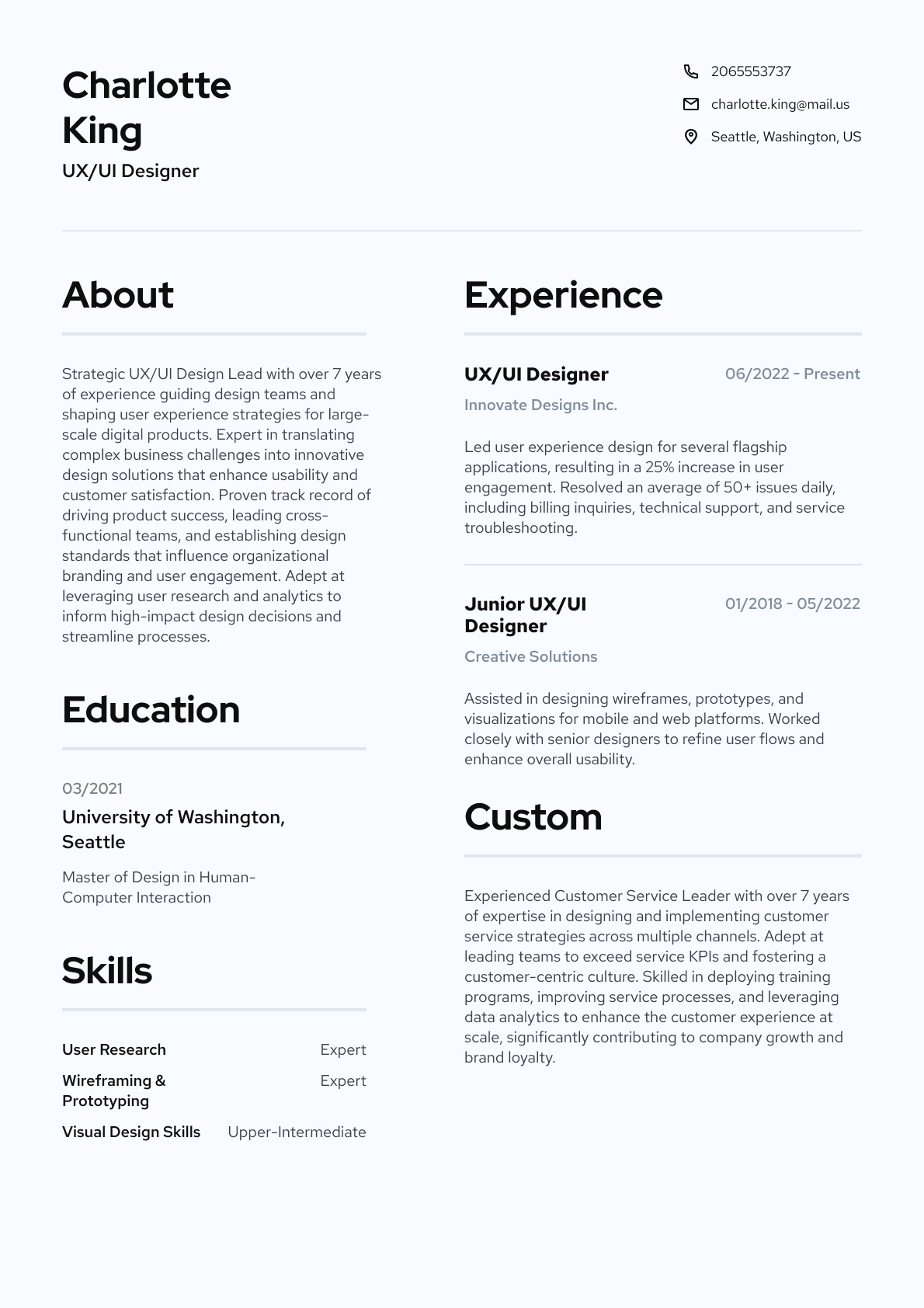
Charlotte King
UX/UI Designer
charlotte.king@mail.us 2065553737 Seattle, Washington, US
Profile
Strategic UX/UI Design Lead with over 7 years of experience guiding design teams and shaping user experience strategies for large-scale digital products. Expert in translating complex business challenges into innovative design solutions that enhance usability and customer satisfaction. Proven track record of driving product success, leading cross-functional teams, and establishing design standards that influence organizational branding and user engagement. Adept at leveraging user research and analytics to inform high-impact design decisions and streamline processes.
Work Experience
06/2022 - Present, UX/UI Designer, Innovate Designs Inc., Seattle, Washington
- Led user experience design for several flagship applications, resulting in a 25% increase in user engagement.
- Collaborated with cross-functional teams to create intuitive, user-centered interfaces that aligned with business goals.
- Conducted user research and testing sessions to gather feedback and iteratively improve design prototypes.
- Developed style guides and design systems to ensure consistency across multiple digital products.
01/2018 - 05/2022, Junior UX/UI Designer, Creative Solutions, Seattle, Washington
- Assisted in designing wireframes, prototypes, and visualizations for mobile and web platforms.
- Worked closely with senior designers to refine user flows and enhance overall usability.
- Participated in user interviews and usability testing, contributing to improvements that increased customer satisfaction scores.
- Supported brand consistency by creating cohesive visual elements for various projects.
07/2015 - 12/2017, Graphic Designer, Pixel Perfect Studio, Seattle, Washington
- Designed visual assets and branding materials for digital campaigns and client websites.
- Collaborated with clients to understand their vision and deliver tailored design solutions.
- Contributed to the development of user interface elements for internal software tools.
- Maintained brand consistency and quality across all deliverables.
Education
03/2021, Master of Design in Human-Computer Interaction, University of Washington, Seattle, WA
06/2017, Bachelor of Arts in Graphic Design, Seattle University, Seattle, WA
Skills
- User Research
- Wireframing & Prototyping
- Visual Design Skills
- User-Centered Design Principles
- Communication & Collaboration
How to write a UX/UI Designer resume
Before crafting your resume, understand the essential sections that make a UX/UI Designer resume stand out. These include:
- Profile or Summary
- Work Experience
- Education
- Key Skills
Your resume should clearly convey the unique design perspective and technical expertise you bring as a UX/UI Designer. Start by researching the company and role thoroughly to tailor your resume. Understand the user problems the company aims to solve and position yourself as the ideal designer for those challenges. To do this effectively, follow these guidelines:
- Emphasize your outcomes and design achievements rather than just listing tasks. Demonstrate how your work improved user engagement, conversions, or usability.
- Customize your resume for each job application, adapting tone and style to mirror the employer’s culture.
- Maintain a sleek, modern resume layout — polished yet approachable.
- Incorporate industry-relevant keywords to get past applicant tracking systems and capture hiring managers’ attention.
Choosing the right resume format for UX/UI design
Your UX/UI Designer resume should mirror your design approach: clear, user-friendly, and impactful.
The reverse chronological resume format is generally the best choice, showcasing your most recent design projects and roles first.
If you're pivoting careers or have a unique portfolio, consider a functional format emphasizing skills and design proficiencies over specific roles. A hybrid format combining chronological and functional elements can also be effective.
Browse through our resume templates in the builder to find a format that reflects your experience and style. Numerous UX/UI Designer resume examples can guide you.
Choose a clean, modern, and professional design that represents your personal brand in UX/UI best practices.
Include your contact information
The top section of your resume is crucial for providing your contact details clearly and professionally.
Essential information to include:
- Your full name
- Your professional email address
- Your phone number
- Links to your LinkedIn profile and online portfolio
Avoid including:
- Your full home address
- Personal identifiers irrelevant to the job
Leverage a compelling summary
UX/UI Design combines creativity with user research and technology, making it both a technical and expressive profession. Your resume summary (or profile) offers a chance to introduce your design philosophy, key skills, and what sets you apart.
Think of this section as your design narrative — a blend of expertise and personality. Unlike other bullet-point sections, it allows some flexibility to be concise yet engaging.
Use dynamic language, action verbs, and positive, confident statements while injecting your unique design voice. Avoid redundancy; instead, present overarching themes about your approach, achievements, and collaboration style.
Below you’ll find customizable UX/UI Designer resume summary examples suitable for various experience levels:
Entry-level adaptable resume summary/profile example
Motivated entry-level UX/UI Designer with a strong foundation in user-centered design principles and a portfolio showcasing creative project work. Eager to apply academic training and enthusiasm for innovative design solutions to real-world projects. Skilled in basic wireframing, prototyping, and user research, with a keen interest in developing user-friendly interfaces. Committed to learning and growing within a dynamic design team.
Mid-level adaptable resume summary/profile example
Experienced UX/UI Designer with over 3 years of successful project delivery, enhancing user experience and engagement for diverse clients. Proficient in wireframing, prototyping, and user research using tools like Sketch, Figma, and Adobe XD. Achieved measurable improvements in user satisfaction scores and conversion rates through thoughtful, data-driven design enhancements. Capable of collaborating across teams to deliver intuitive and visually compelling interfaces that align with business goals.
Senior adaptable resume summary/profile example
Strategic UX/UI Design Lead with over 7 years of experience guiding design teams and shaping user experience strategies for large-scale digital products. Expert in translating complex business challenges into innovative design solutions that enhance usability and customer satisfaction. Proven track record of driving product success, leading cross-functional teams, and establishing design standards that influence organizational branding and user engagement. Adept at leveraging user research and analytics to inform high-impact design decisions and streamline processes.
Detail your UX/UI design work experience
Following a reverse chronological format, list your most recent UX/UI Designer roles first, then work backward through your career history. Limit your experience to the last 10-15 years to remain relevant and avoid potential age bias.
Focus on roles and projects directly relevant to UX/UI design. If you have other professional experiences, consider adding a separate "Other Experience" section.
Under each job title and employer, describe your contributions and achievements using concise bullet points. Omit personal pronouns and start each with strong action verbs like designed, prototyped, collaborated, or tested.
Instead of simply listing responsibilities, emphasize measurable outcomes and improvements. Wherever possible, include specific metrics or KPIs to illustrate your impact.
For instance, these generic bullet points:
- Created user interfaces for company applications
- Conducted usability testing
- Collaborated with development teams
are vague compared to these enhanced examples:
- Designed intuitive UI for a SaaS product used by 50,000+ users, improving user task completion by 30%
- Led usability testing sessions that increased overall customer satisfaction scores by 20%
- Collaborated with cross-functional teams to launch a mobile app, reducing onboarding time by 15%
Review the UX/UI Designer employment history resume sample below for reference:
UX/UI Designer employment history resume sample
06/2022 - Present, UX/UI Designer, Innovate Designs Inc., Seattle, Washington
- Led user experience design for several flagship applications, resulting in a 25% increase in user engagement.
- Collaborated with cross-functional teams to create intuitive, user-centered interfaces that aligned with business goals.
- Conducted user research and testing sessions to gather feedback and iteratively improve design prototypes.
- Developed style guides and design systems to ensure consistency across multiple digital products.
01/2018 - 05/2022, Junior UX/UI Designer, Creative Solutions, Seattle, Washington
- Assisted in designing wireframes, prototypes, and visualizations for mobile and web platforms.
- Worked closely with senior designers to refine user flows and enhance overall usability.
- Participated in user interviews and usability testing, contributing to improvements that increased customer satisfaction scores.
- Supported brand consistency by creating cohesive visual elements for various projects.
07/2015 - 12/2017, Graphic Designer, Pixel Perfect Studio, Seattle, Washington
- Designed visual assets and branding materials for digital campaigns and client websites.
- Collaborated with clients to understand their vision and deliver tailored design solutions.
- Contributed to the development of user interface elements for internal software tools.
- Maintained brand consistency and quality across all deliverables.
Highlight relevant key skills
UX/UI Design blends hard technical skills and soft interpersonal skills. A well-rounded UX/UI Designer resume balances about 90% hard skills, such as proficiency in design tools and methodologies, with soft skills like empathy and communication.
Keep your skills section focused and tailored to each role. Maintaining a master list of your skills helps you select the most relevant ones for every application. Our resume builder offers pre-written skill suggestions, but you can add your own too.
Here’s an example of key skills in a UX/UI Designer resume:
UX/UI Designer key skills resume sample
- User Research
- Wireframing & Prototyping
- Visual Design Skills
- User-Centered Design Principles
- Communication & Collaboration
Showcase your education & certifications
The education section of your resume highlights your academic foundation that supports your UX/UI design expertise. Many UX/UI Designers hold degrees in design, human-computer interaction, computer science, or related fields.
List your highest degree first and omit high school details if you have a college degree. Also include relevant certifications and trainings that demonstrate your commitment to professional growth, such as:
- UX design certifications from Nielsen Norman Group, Interaction Design Foundation, or Coursera
- Courses or certificates in usability testing, prototyping, or design thinking
- Professional memberships in design organizations like AIGA or UXPA
- Internships or apprenticeships relevant to UX/UI design, especially if you're early in your career
UX/UI Designer education & certifications resume sample
03/2021, Master of Design in Human-Computer Interaction, University of Washington, Seattle, WA
06/2017, Bachelor of Arts in Graphic Design, Seattle University, Seattle, WA
Choose the perfect resume layout and design
Your resume's layout, design, and formatting are key to capturing a recruiter's attention and showcasing your UX/UI skills right from the start.
A clean, minimalist, and modern design works best to convey your professionalism, creativity, and focus on user-centered design principles.
Consider what your resume layout communicates about your design aesthetic. For most UX/UI positions, a simple yet visually engaging format is ideal. In some innovative environments, a more creative touch may be appropriate.
Explore our tested resume templates to find one that aligns with your personal brand and eases the formatting process.
UX/UI Designer job market and outlook
The demand for UX/UI Designers continues to rise as companies prioritize customer-centric digital experiences. Employment in this field is projected to grow by approximately 8% through 2031, faster than the average for all occupations.
Growth is fueled by increasing reliance on mobile applications, websites, and software with high usability standards.
According to the U.S. Bureau of Labor Statistics, the median annual wage for UX/UI Designers is around $85,000, with top professionals earning over $130,000 annually.
This positive trend signals strong opportunities for skilled UX/UI Designers in the coming years.
Key takeaways
UX/UI Design is a fast-growing and in-demand profession as businesses focus on user-centered digital products. Job growth is expected to continue at a rate higher than average.
Companies seek skilled designers who can enhance usability, drive engagement, and deliver innovative experiences.
The average salary for a UX/UI Designer is competitive, with senior roles offering substantial earning potential.
Staying current with design trends, tools, and user research methodologies will help maintain your competitive edge in the field.
